The Science-Backed Benefits of Cold Water Immersion (and What It Cannot Do)
Cold water immersion has collected an enormous amount of hype and a real, growing body of research. The two do not always match. Some benefits are well supported by human trials, some are promising but early, and a few are extrapolated from mice. This is an honest tour of what the evidence actually shows, benefit by benefit, and where the confident claims run ahead of the data.
The short answer
Cold water immersion reliably triggers a big acute surge in stress chemicals and metabolism (noradrenaline and dopamine both rise sharply, metabolic rate climbs) and has good short-term human evidence for lower stress (peaking about twelve hours after a session), better mood and sleep, and modestly fewer work sick-days (about 29% fewer in one large trial). The bigger claims, around brown-fat weight loss, blood-sugar control, longevity and anti-aging, are mostly early, mechanistic, or based on animal and small-sample studies, not proven long-term outcomes in healthy people.
In this article
- What happens in your body in the first 60 seconds of cold water?
- Does cold water immersion actually reduce stress?
- How does cold water affect inflammation?
- Does cold exposure boost your immune system?
- Does cold exposure activate brown fat and burn calories?
- Does cold water immersion improve sleep and wellbeing?
- Can cold exposure slow aging?
- What does the evidence actually support?
- How to start cold water immersion safely
Cold water immersion has exploded in popularity. Social media is full of influencers gasping in ice baths, promising everything from fat loss to superhuman focus. Some of those claims are overblown. But when you strip away the hype and look at what peer-reviewed research actually shows, the findings are more compelling , and more nuanced , than most people realize.
This article is a research summary. We’ve pulled from the most recent systematic reviews, clinical trials, and meta-analyses to give you an honest, science-first look at what deliberate cold exposure does to your body and mind. No cherry-picked anecdotes. No bro-science. Just the evidence , and what it means if you’re considering making cold water immersion part of your routine.
What happens in your body in the first 60 seconds of cold water?
The most immediate and well-documented effect of cold water immersion is a powerful neurochemical response. When your body hits cold water , typically 14°C (57°F) or below , it triggers what researchers call the cold shock response, a cascade of physiological changes mediated by the sympathetic nervous system.
One of the landmark studies in this area comes from Šrámek et al. (2000), published in the European Journal of Applied Physiology. Researchers immersed ten healthy men in water at three different temperatures , 32°C (thermoneutral), 20°C, and 14°C , for one hour, measuring hormone levels throughout.
Norepinephrine drives alertness, attention, and mood. Dopamine governs motivation, reward, and focus. These are the same neurotransmitters targeted by medications for depression and ADHD. The fact that a single cold exposure can produce such significant elevations , without pharmaceutical intervention , is what first drew clinical researchers to take cold therapy seriously.
This finding has been replicated across multiple subsequent studies. A 2023 fMRI study published in Biology confirmed that cold water immersion increases neural connectivity between large-scale brain networks , including the prefrontal cortex, anterior insula, and anterior cingulate cortex , structures directly involved in emotional regulation, attention, and self-awareness. Participants reported feeling more alert, active, and attentive, and the brain scans backed it up.
Stanford neuroscientist Dr. Andrew Huberman has pointed out that the dopamine increase from cold exposure is particularly notable because it is long-lasting , sustaining for several hours rather than producing the sharp spike and crash associated with stimulants or addictive substances. That sustained elevation more closely resembles the pharmacological profile of a therapeutic intervention than a quick hit.
Does cold water immersion actually reduce stress?
One of the most interesting findings from recent research is that cold water immersion doesn’t just produce an acute chemical response , it changes how your body handles stress for hours afterward.
The most comprehensive analysis to date comes from Cain et al. (2025), a systematic review and meta-analysis published in PLOS ONE. The University of South Australia team analyzed 11 randomized controlled trials encompassing 3,177 participants , making it the largest review of cold water immersion’s health effects in the general (non-athlete) population.
Cold water immersion appears to recalibrate the body’s stress response over the course of a day. The mechanism is likely related to the controlled activation of the sympathetic nervous system during immersion, followed by a parasympathetic rebound , essentially training the body to downregulate after an acute stressor. Researchers describe this as hormesis: a small, controlled dose of stress that strengthens the system’s capacity to manage future stress.
While cold water initially activates the sympathetic “fight or flight” response, cold water on the face and neck simultaneously stimulates the vagus nerve and parasympathetic system , creating a dual activation that may help recalibrate the autonomic nervous system over time.
How does cold water affect inflammation?
Here’s where the story gets nuanced, and where a lot of popular claims get the science wrong.
The Cain et al. (2025) meta-analysis found that cold water immersion actually increases inflammatory markers immediately (SMD: 1.03, p < 0.01) and at 1 hour post-immersion (SMD: 1.26, p < 0.01). In the short term, cold exposure raises inflammation.
This may sound counterintuitive, but it’s actually consistent with how the body’s immune and repair systems work. The initial spike reflects an acute stress response , a healthy inflammatory cascade that mobilizes immune cells and primes the system for repair.
The long-term picture is different. A 2025 review in Life Sciences by Boulares et al. , specifically examining the relationship between cold exposure and aging , found consistent evidence that regular cold exposure reduces chronic low-grade inflammation over time through several pathways:
NF-κB suppression , cold exposure inhibits this master regulator of inflammatory gene expression, reducing production of cytokines like IL-6 and TNF-α. Cytokine rebalancing , increases in anti-inflammatory IL-10 alongside reductions in IL-1β and IL-8. Enhanced antioxidant defenses , regular winter swimmers show elevated baseline levels of reduced glutathione, a critical intracellular antioxidant.
This distinction between acute and chronic effects is critical. The short-term inflammatory spike is not harmful , it’s the system doing its job. The long-term anti-inflammatory adaptation is where the real health benefits accumulate, particularly for lowering what researchers call “inflammaging”, the chronic, low-grade inflammation associated with aging. This is about general wellbeing, not treating or preventing any specific disease.
Does cold exposure boost your immune system?
One of the most frequently cited studies in cold therapy research is the Dutch Cold Shower Trial (Buijze et al., 2016), published in PLOS ONE. It remains the largest randomized controlled trial on cold water exposure and health outcomes in the general population.
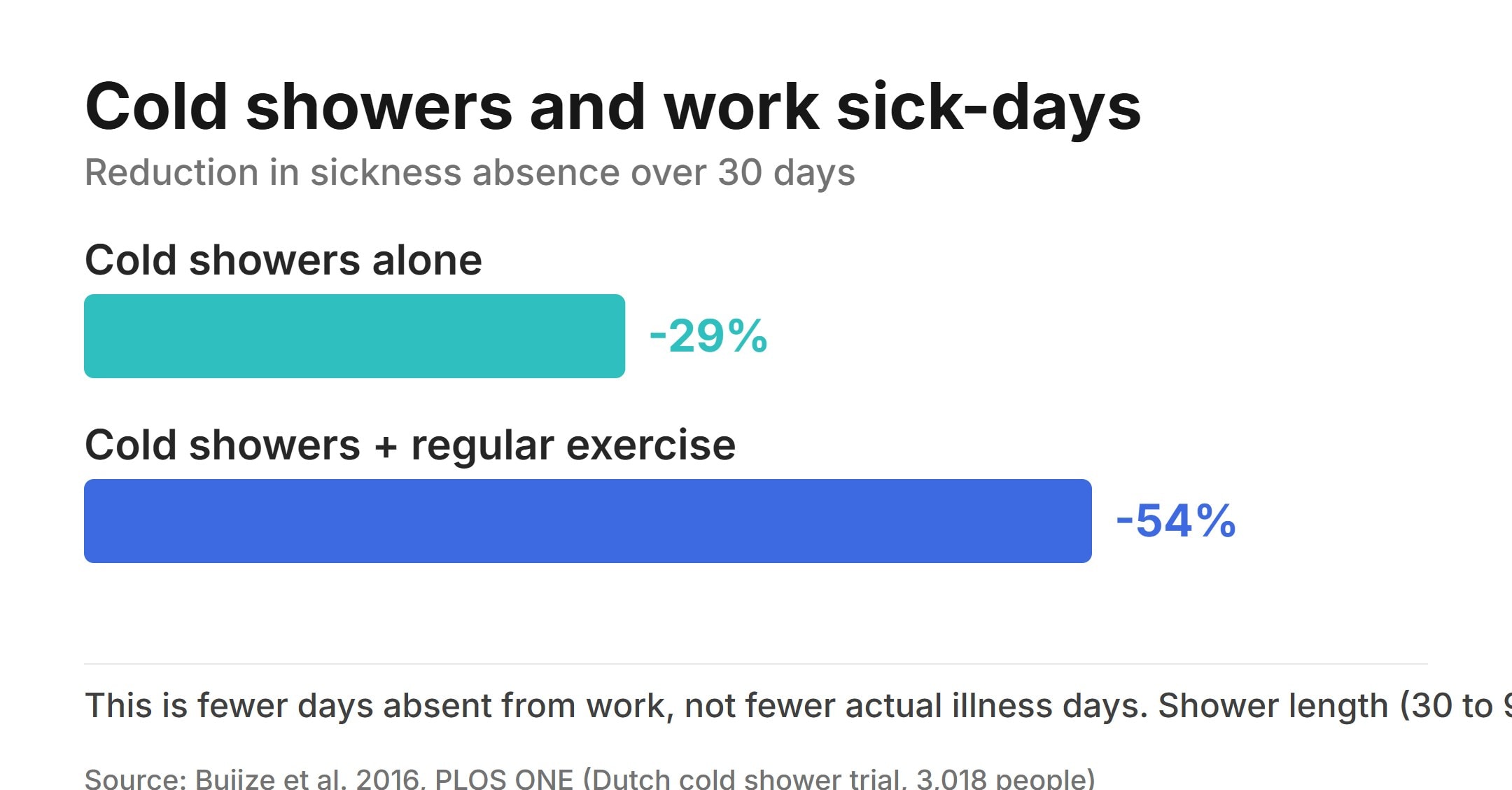
The study enrolled 3,018 participants aged 18-65, randomly assigning them to finish their daily hot shower with 30, 60, or 90 seconds of cold water , or to a control group that showered hot only , for 30 consecutive days.
Interestingly, the cold shower groups did not report fewer days of illness. They got sick just as often , they were simply better able to function through it. As the British Psychological Society summarized, participants “felt ill as frequently as their colleagues, it’s just that somehow they were better able to fight through it and make it to work.”
An important caveat: the Cain et al. (2025) meta-analysis found no significant effects on immune cell counts in the short term. The immune benefits appear to be functional rather than cellular , they’re about how effectively the immune system operates under real-world conditions, not about producing more white blood cells.
Does cold exposure activate brown fat and burn calories?
One of the most promising areas of cold exposure research involves brown adipose tissue (BAT) , commonly called “brown fat.” Unlike regular white fat, which stores energy, brown fat burns energy to produce heat. It’s essentially a built-in furnace.
For decades, brown fat was thought to be relevant only in infants. A landmark 2009 study in the New England Journal of Medicine changed that by demonstrating that 96% of healthy adult men showed active brown fat during mild cold exposure (16°C), though activity was significantly lower in overweight or obese subjects.
The metabolic implications extend beyond calorie burning. In one small clinical study of eight patients with type 2 diabetes (Hanssen et al., 2015, Nature Medicine), short-term cold acclimation improved insulin sensitivity. That is an early therapeutic finding in a patient group, not a proven benefit for healthy people, and cold exposure is not a diabetes treatment. Separate studies of cold water swimmers aged 48-68 found reductions in triglycerides, improvements in apolipoprotein ratios, and decreased body mass.
Boulares et al. (2025) specifically noted that while aging naturally reduces brown fat activity, cold exposure can re-stimulate it even in older adults , making it one of the few interventions that directly counteracts this aspect of metabolic aging. During immersion at 14°C, metabolic rate increased by 350% in the Šrámek et al. study , a significant energy expenditure, though it occurs during exposure rather than representing all-day calorie burning.
Does cold water immersion improve sleep and wellbeing?
Sleep is one of the areas where cold therapy claims are widespread but the evidence base is still developing. The Cain et al. (2025) review identified that sleep quality improved in men following cold water immersion sessions, though the data is currently too limited to draw conclusions for women or the general population.
What makes this finding plausible is the neurochemical and autonomic profile of cold exposure. The parasympathetic rebound that follows the initial sympathetic activation , combined with sustained norepinephrine release, which modulates the sleep-wake cycle , creates a physiological state consistent with improved sleep architecture.
Beyond specific biomarkers, the Dutch Cold Shower Trial found that participants in the cold shower groups reported higher scores on the mental component of quality of life at 30 days. What’s notable is the consistency of self-reported positive experiences across studies , participants regularly described feeling more energetic, more alert, and more capable of managing daily stress.
I think the main mental health benefits of cold water immersion are psychological. It can be scary, so when you are doing it, you are overcoming your fear. This feels good, like mastering any difficult feat.
Stanford addiction researcher Dr. Anna Lembke, author of Dopamine Nation, has proposed a related and still speculative idea: that the natural, sustained dopamine rise from cold exposure might help balance the brain’s reward system against the short, sharp spikes linked to addictive behaviors. This is a hypothesis, not a proven effect. Whether the benefit comes from neurochemistry, behavioral psychology, or both, the outcome for the practitioner is the same.
Can cold exposure slow aging?
Perhaps the most ambitious claim about cold exposure is that it can slow biological aging. The evidence here is still emerging and comes largely from animal and mechanistic studies, so it is genuinely interesting but far from settled in humans.
Boulares et al. (2025) compiled findings across multiple model organisms and human studies, identifying several pathways through which cold exposure may counteract aging:
Reduced inflammaging. Chronic low-grade inflammation is now recognized as one of the primary drivers of biological aging. Cold exposure’s ability to suppress NF-κB signaling and shift the cytokine balance toward anti-inflammatory profiles directly addresses this.
Enhanced antioxidant defenses. Oxidative stress is a core driver of the aging process. Regular cold exposure upregulates the body’s enzymatic antioxidant systems, including elevated glutathione levels in habitual winter swimmers.
Brown fat reactivation. Since brown fat activity naturally declines with age, and cold exposure can reactivate it, this represents a direct metabolic reversal of an age-related change.
Insights from nature. Hibernating mammals tend to outlive similar non-hibernating species, several model organisms live longer at colder temperatures, and mice with slightly reduced core body temperatures have shown roughly 12 to 20% longer lifespans. Every one of these findings is from animals, not people, so read them as mechanism and hypothesis, not evidence that cold makes humans live longer.
Cellular maintenance. Emerging research suggests cold exposure may delay cellular senescence and support proteostasis , the balance of proteins within cells , by activating proteasomes that degrade damaged proteins.
Controlled, intermittent cold exposure (ice baths, cold plunges) is fundamentally different from chronic environmental cold, which carries cardiovascular risks. The concept is hormesis , a measured dose of stress that triggers adaptive responses, much like exercise.
What does the evidence actually support?
Intellectual honesty requires acknowledging limitations. Most trials beyond the Dutch study had small sample sizes. Study populations were predominantly male. Protocol temperatures, durations, and methods varied widely. And you can’t exactly give someone a placebo ice bath. None of these invalidate the findings , they mean the evidence is promising and directionally strong rather than fully conclusive.
Here’s what the combined body of evidence supports, ranked by strength:
- Large, sustained increases in norepinephrine and dopamine , linked to mood, focus, and motivation
- Activation of brown adipose tissue and increased energy expenditure
- Reduction in chronic inflammation markers with regular practice
- 29% reduction in sickness absence, especially combined with exercise
- Stress levels reduced approximately 12 hours post-immersion
- Quality of life measures improve with regular practice
- Sleep quality may improve, particularly in men
- Cold exposure may support healthy aging through several mechanisms, but this rests mostly on animal and early evidence
- A hypothesised role in balancing the brain’s reward system, alongside better mental resilience
How to start cold water immersion safely
The research points to a few consistent principles for effective cold water immersion:
Timing: While the research doesn’t definitively favor morning over evening, the sustained dopamine and norepinephrine elevation makes morning plunges a logical choice for energy and focus. Note that immediate post-strength-training cold immersion may slightly blunt muscle hypertrophy , spacing it 4+ hours from resistance training may be optimal.
Frequently asked questions
What are the proven benefits of cold water immersion?
The best-supported human benefits are short-term: a sharp rise in alertness chemicals, lower stress that peaks around twelve hours after a session, better mood and sleep in several studies, and modestly fewer work sick-days in one large trial. Weight loss, blood-sugar and longevity benefits are far less certain.
Does cold water immersion boost your immune system?
A 3,018-person trial found people taking cold showers had about 29% fewer days absent from work. Importantly, they did not have fewer actual illness days, so the effect is real but is not proof that cold showers stop you getting sick.
Does cold exposure burn fat or help you lose weight?
Cold activates brown fat, which burns energy to make heat, and regular exposure can increase its capacity. But the calorie amounts are modest and there is no strong evidence that cold plunging alone produces meaningful weight loss in people.
Can cold exposure slow aging?
This is the most speculative claim. It is supported mainly by animal studies and mechanisms such as reduced chronic inflammation. There is no direct human evidence that cold exposure extends lifespan, so treat anti-aging claims as emerging, not established.
Is cold water immersion safe for everyone?
No. The cold-shock response is a real risk, and anyone with a heart condition, uncontrolled blood pressure, or a seizure disorder should speak to a doctor first. Never plunge alone in open water, and ease in gradually rather than chasing extreme cold or long durations.
The reliable benefits reward consistency, not extremes
Most of the well-supported effects, lower stress, better mood and sleep, come from short, regular sessions rather than punishing ones. A controlled, repeatable plunge makes consistency easy. The Vitalis 3 holds any set point from 2 to 40°C, so you can find a dose you will actually keep doing.
- Sramek P, Simeckova M, Jansky L, Savlikova J, Vybiral S (2000). Human physiological responses to immersion into water of different temperatures. European Journal of Applied Physiology 81(6):436-442. doi.org/10.1007/s004210050065
- Cain T, Brinsley J, Bennett H, et al. (2025). Effects of cold-water immersion on health and wellbeing: a systematic review and meta-analysis. PLOS ONE 20(1):e0317615. doi.org/10.1371/journal.pone.0317615
- Buijze GA, Sierevelt IN, van der Heijden BCJM, et al. (2016). The effect of cold showering on health and work: a randomized controlled trial. PLOS ONE 11(9):e0161749. doi.org/10.1371/journal.pone.0161749
- van Marken Lichtenbelt WD, Vanhommerig JW, Smulders NM, et al. (2009). Cold-activated brown adipose tissue in healthy men. New England Journal of Medicine 360(15):1500-1508. doi.org/10.1056/NEJMoa0808718
- Blondin DP, Labbe SM, Tingelstad HC, et al. (2014). Increased brown adipose tissue oxidative capacity in cold-acclimated humans. J Clin Endocrinol Metab 99(3):E438-E446. doi.org/10.1210/jc.2013-3901
- Hanssen MJW, Hoeks J, Brans B, et al. (2015). Short-term cold acclimation improves insulin sensitivity in patients with type 2 diabetes mellitus. Nature Medicine 21(8):863-865. doi.org/10.1038/nm.3891
- Yankouskaya A, Williamson R, Stacey C, et al. (2023). Short-term head-out whole-body cold-water immersion facilitates positive affect and increases interaction between large-scale brain networks. Biology 12(2):211. doi.org/10.3390/biology12020211
- Espeland D, de Weerd L, Mercer JB (2022). Health effects of voluntary exposure to cold water: a continuing subject of debate. Int J Circumpolar Health 81(1):2111789. doi.org/10.1080/22423982.2022.2111789
- Boulares A, Jdidi H, Douzi W, et al. (2025). Cold and longevity: can cold exposure counteract aging? Life Sciences 364:123431. doi.org/10.1016/j.lfs.2025.123431