Red Light Therapy: What 660nm and 850nm Actually Do
Search “red light therapy” and you will drown in confident percentages: exact wrinkle reductions, precise penetration depths, tidy recovery numbers. Most of it comes from pages selling a device. This is the version written the other way around: what the peer-reviewed evidence actually supports, where it is genuinely strong, and where it is thin enough that the honest answer is “we do not know yet.” The aim is that you finish knowing what red light can do for you, and what it cannot.
The short answer
Red and near-infrared light are absorbed by cytochrome c oxidase inside your mitochondria, which can prompt cells to make more energy (ATP). The strongest human evidence is for skin, where a controlled trial improved collagen density and the look of wrinkles. Muscle-recovery and pain evidence is moderate and works best alongside training, not on its own. Sleep evidence is preliminary, from one very small study. 660nm acts on the surface and 850nm reaches deeper, but the rule that matters most is that dose beats power: more is not better.
| Wavelength | Where it lands | Best-supported use | Dosing unit |
|---|---|---|---|
| 660nm (red) | Skin surface and dermis | Skin: collagen, roughness, wrinkles | Fluence (J/cm2) |
| 850nm (near-infrared) | Deeper, toward muscle and joints | Muscle recovery and pain, as an add-on to exercise | Fluence (J/cm2) |
In this article
- How does red light therapy actually work?
- What is the difference between 660nm and 850nm?
- Does red light therapy work for skin?
- Does it help muscle recovery and soreness?
- Can it help with pain, tendons, and inflammation?
- Does red light before bed improve sleep?
- What dose, distance, and session length should you use?
- Is it safe, and what should you expect in Singapore?
How does red light therapy actually work?
The headline mechanism is real and reasonably well mapped. Red and near-infrared light are absorbed by cytochrome c oxidase, an enzyme in your mitochondria that acts as the main light receptor in this range. That absorption is the first domino.
From there, the leading explanation is that the light knocks nitric oxide off that enzyme, lifting a brake on the electron transport chain and letting the cell produce more ATP, its basic energy currency. More available energy is the plausible reason cells behave differently after exposure.
That said, the mechanism is proposed, not settled. When researchers removed cytochrome c oxidase from cells, red light at 660nm still increased their proliferation, which means the story is more complicated than “light hits one enzyme and everything follows.” The effects are real; the exact pathway is still being worked out. Anyone who tells you it is fully understood is overselling.
What is the difference between 660nm and 850nm?
Wavelength is about where the energy lands, not about magic. 660nm is red light, absorbed close to the surface, in the skin and the dermis just beneath it. 850nm is near-infrared, invisible to your eye, and it passes through tissue more easily, so more of it reaches deeper structures like muscle and joints. Neither is “better.” They suit different jobs: red for skin, near-infrared for tissue you cannot see.
This is also where marketing gets loud. You will see claims that 850nm penetrates 40 to 50mm, roughly two inches, into the body. Tissue optics do not support numbers like that. In practice the meaningful dose reaches on the order of a few millimeters, with near-infrared traveling somewhat further than red. So the useful takeaway is directional, not a precise depth: 660nm for the surface, 850nm for deeper. Treat any device that advertises dramatic centimeter-deep penetration with skepticism.
Most quality panels run several wavelengths at once, so you are not forced to choose. That is sensible, as long as the irradiance and the dose are right, which matter far more than the exact wavelength mix.
Does red light therapy work for skin?
Skin is where the human evidence is strongest. In a controlled trial of 136 volunteers, twice-weekly red and near-infrared light significantly improved skin complexion, measured roughness, and collagen density compared with an untreated control group. Participants also reported softer, better-feeling skin. This is a real study with a control group, not a testimonial.
Two details matter. First, the dose was modest, normalized to about 9 J/cm2, which reinforces a theme you will see throughout this article: low, sensible doses do the work. Second, the improvements were in the appearance and structure of skin, a cosmetic and wellness outcome. That is the honest ceiling of the claim: better-looking skin, not a medical treatment.
Does it help muscle recovery and soreness?
For recovery the picture is promising but softer. A 2025 systematic review pooled the available trials and found a moderate reduction in muscle soreness at 72 and 96 hours, with standardized effect sizes of about -0.55 and -0.56, plus a large improvement in strength recovery at 24 and 48 hours, near 0.97 and 0.99. In plain terms, a standardized effect size compares the size of a benefit across studies: moderate is a noticeable nudge, large is a clear one.
Here is the part the recovery marketing skips. That same review could only pool four of the fourteen studies it screened, because the rest did not report their data clearly enough, and the studies it did combine disagreed with each other a great deal. The authors themselves call for larger, better-designed trials before the evidence can be considered solid. So there is a genuine signal for recovery, resting on a thin stack of clean studies. Encouraging, not settled.
Can it help with pain, tendons, and inflammation?
For tendon pain the most useful finding is about how you use it. A meta-analysis of 17 trials in 835 people found that light therapy added to an exercise programme reduced pain more than sham light plus the same exercise, a mean difference of about 1.06 points. Used on its own, though, light with no exercise produced essentially no pain benefit. The clear message: it is a helper for rehab, not a replacement for the work that actually fixes tendons.
The reviewers also graded the overall certainty of this evidence as very low to moderate, which is a reason to keep expectations grounded. As for the popular “anti-inflammatory” label, it is conditional. Light can raise reactive oxygen species in healthy cells but lower them in cells that are already stressed, so the effect depends on context rather than being an across-the-board calming of inflammation.
Does red light before bed improve sleep?
Sleep is the most preliminary claim in this article, and it is worth being upfront about that. In a small trial, athletes who received 30 minutes of red light each night for two weeks ended with higher nightly melatonin than a placebo group, about 38.8 versus 23.8 pg/mL, and reported better sleep. It is a genuinely interesting result.
But it was twenty female athletes from a single team: one specialized group, one small study, not replicated broadly. That is not enough to promise anything about your sleep. Treat red light as a plausible, low-risk thing to try before bed, not as an established sleep aid. If sleep is a real problem, the basics with far stronger evidence, consistent timing, daylight, and a cool dark room, come first.
What dose, distance, and session length should you use?
This is the part that actually determines whether red light does anything for you, and it is the part most guides get wrong. The “dose” is fluence, measured in joules per square centimeter (J/cm2), and the response is biphasic: a low-to-moderate dose helps, while too much reverses the benefit. Cranking the power is not a shortcut. In one experiment, increasing the intensity tenfold wiped out the benefit entirely. More is not better; it can be worse.
For muscle work, published dosing guidance lands in the range shown below: roughly 20 to 60 joules for a small muscle group and 60 to 300 joules for a large one. For large muscles the same paper found the upper part of that window, 120 to 300 joules, produced better outcomes than going above 300 joules, so aim toward the top of the range and treat 300 joules as the ceiling.
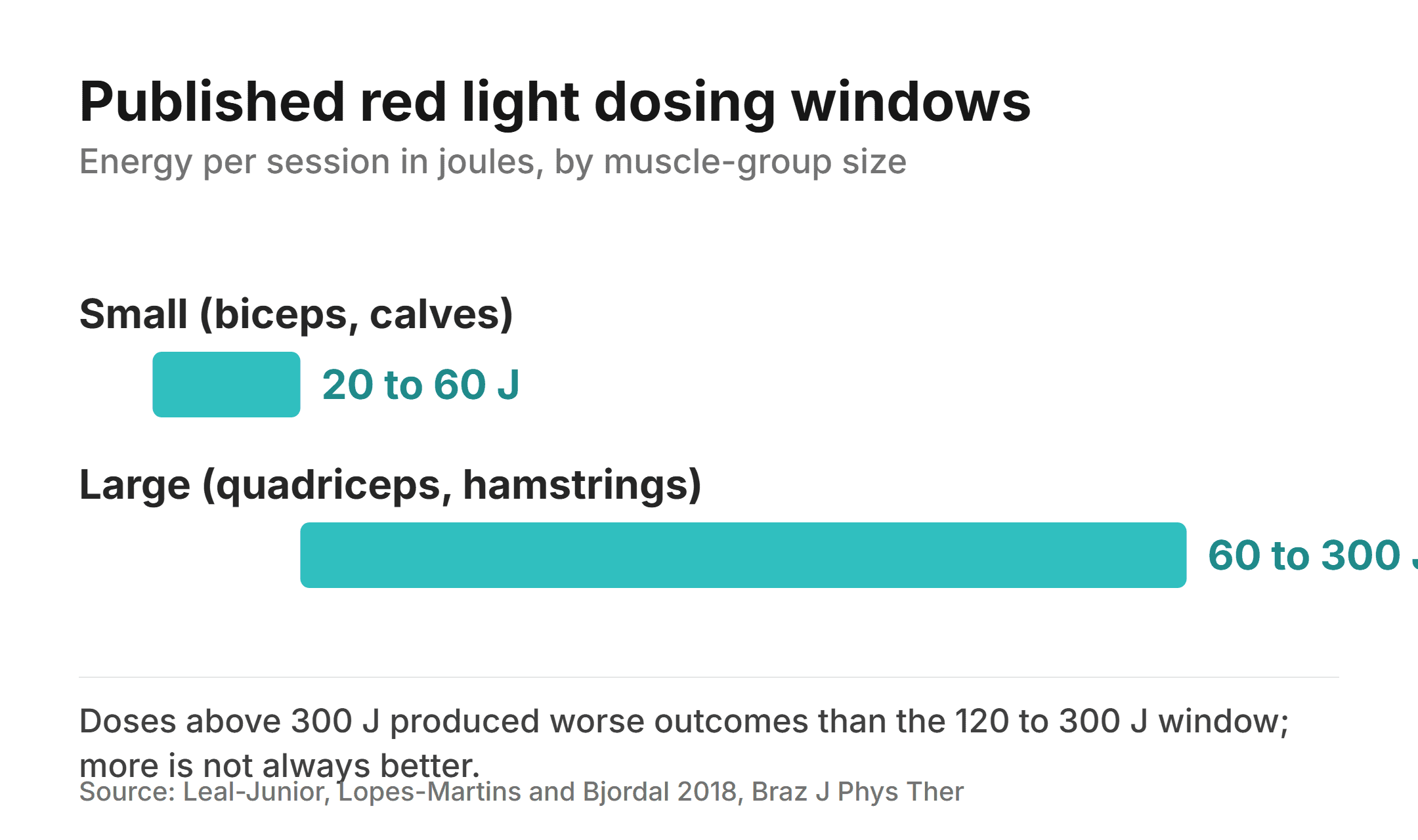
In practice, session length is simply the dose divided by how much light actually reaches you, so a stronger panel needs less time and a weak one may never deliver enough. That is why the single most useful spec on a panel is its irradiance at the distance you actually sit, not its wattage or its wavelength count. Sessions are short by design, a few focused minutes per area rather than long exposures, and sitting a sensible distance back beats pressing against the panel. A high-irradiance option like the Solis red light panel makes reaching a proper dose in a short session straightforward, without guesswork.
Is it safe, and what should you expect in Singapore?
Red light devices are generally considered safe for skin, and side effects are usually mild. But two honest caveats belong on every panel’s box. First, the long-term effects on skin and hair are not yet known. Second, it is genuinely hard to say how well at-home devices perform compared with clinic equipment. Protect your eyes from prolonged direct exposure to bright panels, and treat red light as a wellness tool, not a medical treatment. If you have a health condition or a skin concern, speak to a doctor first; light is not a substitute for care.
For Singapore specifically, red light has one clear practical advantage: it is indoor and year-round. Unlike a cold plunge, there is no chiller or tap-water-temperature battle, so it works exactly the same on a 32°C afternoon as it does at dawn. On cost, the arithmetic is simple: studio LED sessions are a recurring fee every visit, while a home panel is a one-time purchase you can use daily. A panel like the Solis, at $1,840, carries a 12-month warranty with a free extension to 18 months when you register it, worth checking against any device you compare. The honest framing for a Singapore buyer: choose on irradiance and build quality, ignore penetration-in-centimeters claims, and be wary of any device marketed as treating a medical condition.
Frequently asked questions
Does red light therapy really work?
For some things, yes, with honest limits. The evidence is strongest for skin, moderate for muscle recovery and for tendon pain when paired with exercise, and only preliminary for sleep. It is a real, dose-dependent tool rather than a cure-all, and it works best as one supportive habit, not a standalone fix.
Is 660nm or 850nm better?
Neither. They do different jobs. 660nm red light is absorbed near the surface and suits skin. 850nm near-infrared reaches deeper toward muscle and joints. Many panels combine both, and what matters more than the exact wavelength is delivering a sensible dose at real irradiance.
How long until you see results?
It depends on the goal and is not precisely established. Recovery effects in studies show up within a day or two of a session, while skin changes were measured over weeks of twice-weekly use. Consistency matters more than intensity, and results are individual, so treat any fixed timeline with caution.
How far should you sit from a red light panel?
Far enough to be comfortable and cover the area, close enough to receive real irradiance, which usually means a short distance rather than pressed against the panel. Because dose is irradiance multiplied by time, the right distance depends on your specific panel, so check the manufacturer’s irradiance figure at a stated distance.
Can you overdo red light therapy?
Yes. Light therapy follows a biphasic dose-response, so more is not better. In research, raising the intensity tenfold erased the benefit. Longer and stronger is not the goal; a sensible dose for a few minutes is. When in doubt, do less.
A panel that makes the dose easy
The whole game with red light is delivering a sensible dose at real irradiance, in a session short enough to actually repeat. The Solis runs multiple wavelengths at high irradiance, so a few focused minutes does the work, with no guessing about whether the light is reaching you.
- Salehpour F, Mahmoudi J, Kamari F, Sadigh-Eteghad S, Rasta SH, Hamblin MR (2018). Brain photobiomodulation therapy: a narrative review. Molecular Neurobiology 55(8):6601-6636. pmc.ncbi.nlm.nih.gov/articles/PMC6041198
- Lima ACG, et al. (2019). Photobiomodulation enhancement of cell proliferation at 660 nm does not require cytochrome c oxidase. Journal of Photochemistry and Photobiology B 194:71-75. pubmed.ncbi.nlm.nih.gov/30927704
- Wunsch A, Matuschka K (2014). A controlled trial to determine the efficacy of red and near-infrared light treatment in patient satisfaction, reduction of fine lines, wrinkles, skin roughness, and intradermal collagen density increase. Photomedicine and Laser Surgery 32(2):93-100. journals.sagepub.com/doi/10.1089/pho.2013.3616
- Tsou HC, Chang YC, Chang CH (2025). Effects of photobiomodulation therapy on delayed-onset muscle soreness and muscle recovery: a systematic review and meta-analysis. Journal of Functional Morphology and Kinesiology 10(3):277. pmc.ncbi.nlm.nih.gov/articles/PMC12286287
- Tripodi N, et al. (2021). The effects of photobiomodulation therapy as an adjunct to exercise on pain and function in musculoskeletal conditions: a systematic review and meta-analysis. BMC Sports Science, Medicine and Rehabilitation 13:91. pmc.ncbi.nlm.nih.gov/articles/PMC8364035
- Hamblin MR (2017). Mechanisms and applications of the anti-inflammatory effects of photobiomodulation. AIMS Biophysics 4(3):337-361. pmc.ncbi.nlm.nih.gov/articles/PMC5523874
- Zhao J, Tian Y, Nie J, Xu J, Liu D (2012). Red light and the sleep quality and endurance performance of Chinese female basketball players. Journal of Athletic Training 47(6):673-678. pmc.ncbi.nlm.nih.gov/articles/PMC3499892
- Huang YY, Sharma SK, Carroll J, Hamblin MR (2011). Biphasic dose response in low level light therapy: an update. Dose-Response 9(4):602-618. pmc.ncbi.nlm.nih.gov/articles/PMC3315174
- Leal-Junior ECP, Lopes-Martins RAB, Bjordal JM (2018). Clinical and scientific recommendations for the use of photobiomodulation therapy in exercise performance enhancement and post-exercise recovery. Brazilian Journal of Physical Therapy 23(1):71-75. pmc.ncbi.nlm.nih.gov/articles/PMC6546960
- American Academy of Dermatology. Red light therapy: safety and what to know. aad.org/public/cosmetic/safety/red-light-therapy