Red Light Therapy in Singapore: Clinics vs Home Panels
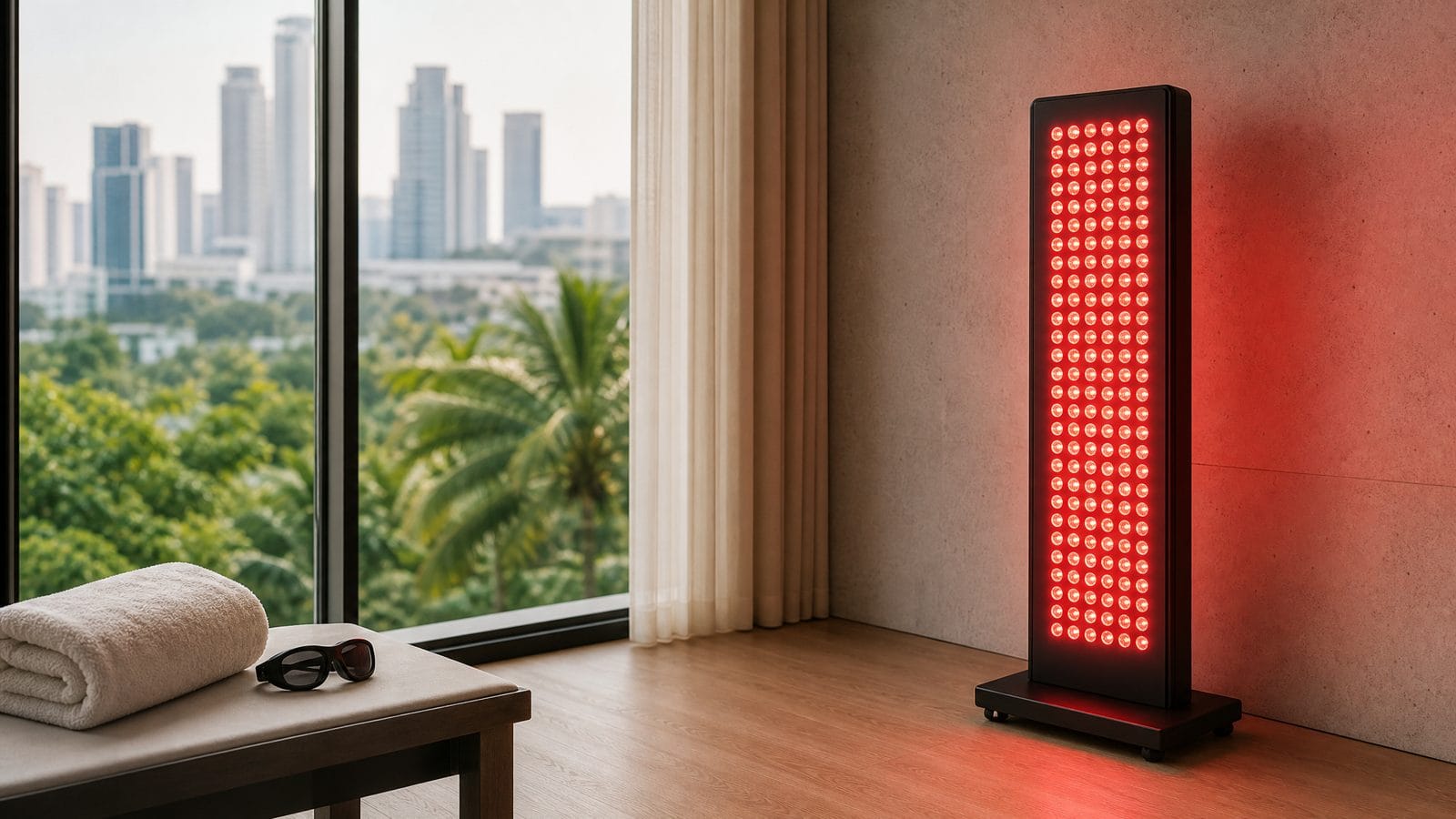
Singapore now has whole-body light pods in Katong, LED beds on Orchard Road, and panels you can hang on the back of a bedroom door. The question is no longer whether you can get red light here. It is which way of buying it actually makes sense for your money, and how to tell a serious device from an expensive one. This guide runs the real numbers in Singapore dollars, names where to go, and gives you a short checklist to use before you spend anything.
The short answer
Clinic red light sessions in Singapore list at S$50 to S$300, and unlimited studio memberships run about S$295 to S$369 a month. A quality home panel is a one-time S$1,000 to S$1,900 plus roughly S$4 a year in electricity at the current SP Group tariff, so at three sessions a week it overtakes every clinic option in about six months and keeps widening the gap after that. Before you buy, check measured irradiance, flicker, EMF and the IEC 62471 eye-safety rating, because independent testing in 2026 found devices delivering anywhere from 67 percent to nearly triple their advertised power. Red light is genuinely promising for skin and recovery, but the evidence is still maturing, so treat any disease-cure claim as a red flag. In Singapore, wellness panels that make no medical claims are not registered as HSA medical devices, and that is normal rather than a warning sign.
| Option, as listed | Price per session (SGD) |
|---|---|
| Typical spa or clinic session, low end | S$50 |
| Wellaholic LED, single session | S$79 |
| Typical spa or clinic session, high end | S$100 |
| Premium clinic or bed session, top of market | S$300 |
| Wellaholic 12-session pack, per session | S$63 |
| HelloPhysio 2-week unlimited, at 5 sessions used | S$47 (our math) |
In this article
- How much does red light therapy cost in Singapore?
- Where can you get red light therapy in Singapore?
- Are clinic sessions stronger than a home panel?
- When does a home panel become cheaper than clinic sessions?
- What should you check before buying a red light panel in Singapore?
- Is red light therapy regulated in Singapore?
- Is red light therapy safe?
How much does red light therapy cost in Singapore?
Pay-as-you-go pricing spans a wide band. A local med-spa states that professional sessions typically range from S$50 to S$100, which is the honest middle of the market. At the chain end, Wellaholic lists a single LED session at S$79, falling to about S$63 a session on a 12-session pack, with unlimited monthly plans between S$295 and S$369. One distributor’s buyer guide puts the full market range, including premium clinic beds, at S$80 to S$300 per session.
What drives the spread is the device and the format. A quick facial LED at a beauty chain is not the same as twenty minutes on a clinical bed. HelloPhysio, for example, sells a two-week unlimited bed package at S$235, capped at two sessions a day. Use it five times in the fortnight and that works out to about S$47 a session, our own arithmetic on their listed price. Packages and memberships always beat single-session rates, so if you are comparing clinics, compare the effective per-session cost after the discount, not the sticker price on the door.
Where can you get red light therapy in Singapore?
The local scene splits into a few formats. For whole-body exposure, Avantir Wellness in Katong runs a NovoTHOR red and near-infrared pod with twenty-minute sessions, priced by inquiry rather than published. For a lie-down bed, HelloPhysio on Orchard and at Raffles Place uses a LightStim MultiWave bed with 630 and 660nm red plus 855 and 940nm infrared across roughly 18,240 LEDs.
For facial LED, the chains are easiest to book: Wellaholic and Chrysalis both run red-light services across multiple outlets at the prices above. A media round-up of the city’s options also names Nueva, Astique, Halley Medical Aesthetics, Aesthetic Chapter, Rekoop and Radium Wellness among the clinics and studios offering red light, though most publish no prices and quote on inquiry. The pattern is clear: beds and pods are where the strong, whole-body sessions live, while the affordable, walk-in options are mostly facial panels aimed at skin.
Are clinic sessions stronger than a home panel?
Sometimes, and it is worth being precise about why. The Cleveland Clinic notes that home products are generally safe to use but may be less powerful than devices used by dermatologists or other trained skin professionals. That is fair as a general statement about cheap masks. It is not a law of physics.
What actually matters is dose, and dose is simply irradiance multiplied by time. A clinical pod wraps the whole body in light at once, which is its real advantage. But a well-specified home panel closes the power gap through two things a clinic cannot give you: proximity and consistency. You control the distance, and you can use it daily rather than whenever you can book a slot. If you want more depth on specs and dose, our companion piece on how to choose a red light panel goes further. The short version for buying: a strong panel used consistently at close range is not the weakling in this comparison. A vague panel with an inflated power claim is.
When does a home panel become cheaper than clinic sessions?
This is where the numbers stop being close. At three sessions a week, a year is about 156 sessions. On clinic pricing that is roughly S$7,800 at S$50 a session, or over S$12,000 at S$79. Even the most efficient clinic path, an unlimited membership at the 12-month rate of S$295 a month, still totals S$3,540 in year one. A home panel is a single purchase that you then run for years.
How much does running it actually cost? Singapore residential electricity is 31.91 cents per kWh before GST this quarter. A panel drawing around 300 watts for a 15-minute session uses about 0.075 kWh, or roughly 2.4 cents. Run it 156 times a year and you spend about S$4 on electricity. So a CurrentBody full-body panel at S$1,599 or a Cool Bionic Solis at S$1,840 lands near S$1,600 to S$1,844 all-in for the first year, and closer to S$4 a year after that.
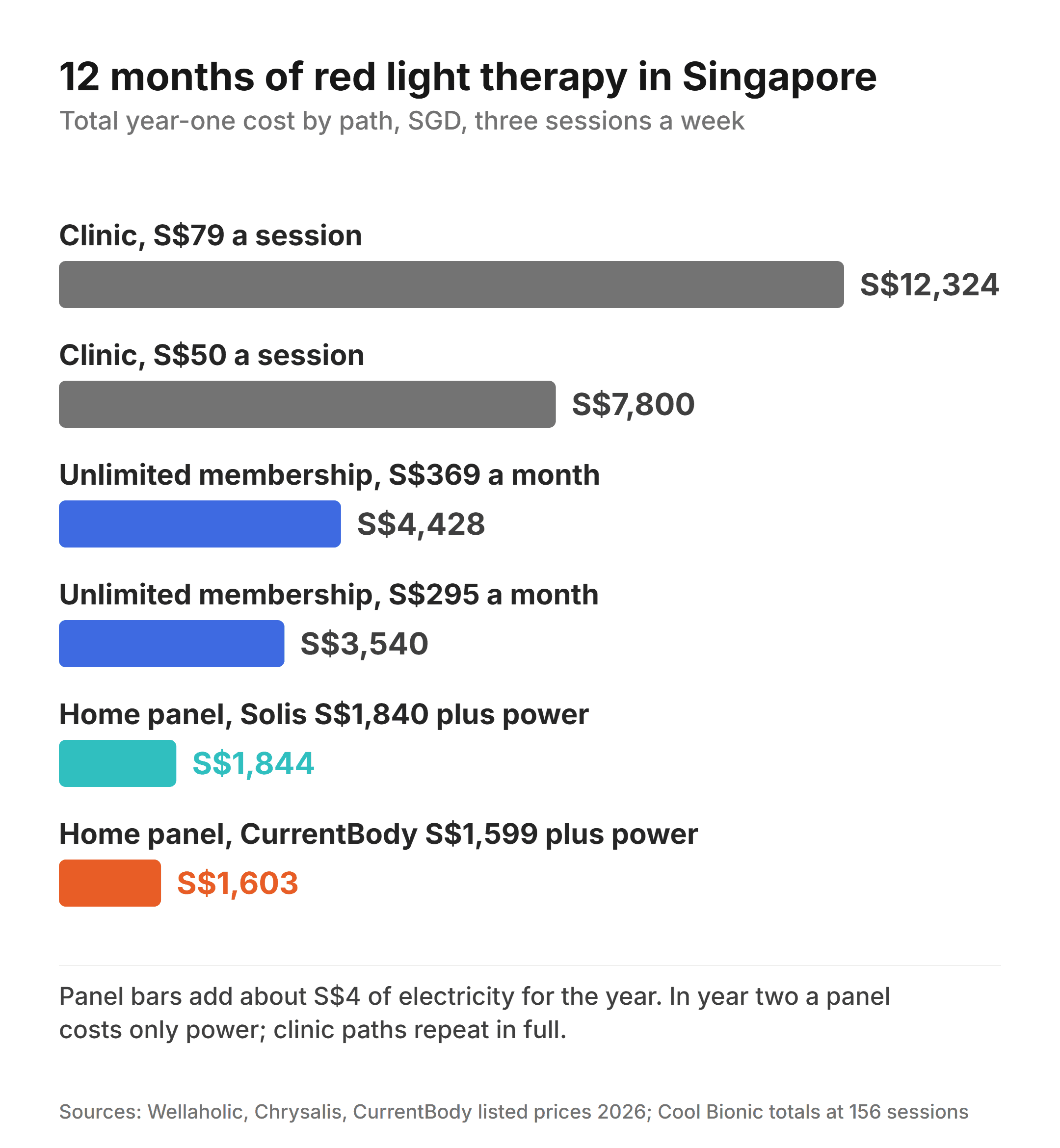
Put plainly: against a S$50 clinic habit at three sessions a week the panel pays for itself inside three months, and against an unlimited membership it breaks even in about six, our own arithmetic on the listed prices. In year two the panel costs only electricity, so its effective price drops to a few dollars a session and keeps falling, while every clinic path repeats in full. Buying overseas can look cheaper on the label, for instance a BonCharge Max at US$999, but add international shipping and 9 percent GST on import before you compare it with a locally stocked, locally warranted panel.
What should you check before buying a red light panel in Singapore?
The single most important habit is to trust measured numbers, not advertised ones. In July 2026, independent spectrometer testing found that across popular devices, one lamp measured nearly three times its published irradiance while a red and near-infrared panel delivered as little as 67 percent of its advertised figure. In other words, the number on the box is often fiction in both directions. Run through five checks before you pay.
- Irradiance. Look for a power figure measured at a stated distance, not a headline number with no conditions. A panel that publishes its irradiance at, say, three inches is telling you something checkable.
- Wavelength mix. You want red in the 630 to 660nm range plus near-infrared around 810 to 850nm, with per-LED counts stated. Beware anyone claiming a single magic wavelength. Our science guide on what 660nm and 850nm actually do covers why the mix matters.
- Flicker. Cheap drivers pulse the light. Industry guidance and the IEEE 1789-2015 standard point to imperceptible flicker, ideally a flicker-free direct-current drive, which sensitive users notice the absence of.
- EMF. One manufacturer’s buying guide suggests the magnetic field at normal user distance should sit below 3 microtesla and approach zero. Treat that as reasonable industry guidance rather than a health standard.
- Eye safety. The IEC 62471 photobiological safety standard sorts devices into risk groups, and RG0 is the ideal for unsupervised home use. Use the supplied goggles for close facial sessions regardless.
As a worked example of what publishing real specs looks like, the Solis red light panel lists seven wavelengths from 630 to 1060nm, states output exceeding 217mW/cm² at three inches, and specifies zero EMF and flicker-free output, on 220 to 240V Singapore mains. It ships with a 12-month warranty that extends free to 18 months on registration, with standard delivery in one to three working days. Whatever brand you choose, the point is the same: buy the panel that shows its measurements.
The shopper deserves the measured figure before spending a thousand dollars on the advertised one.
Outliyr independent spectrometer testing, July 2026
Is red light therapy regulated in Singapore?
This is the part most guides get wrong, so it is worth stating precisely. Under Singapore’s framework, products used to maintain or support general well-being without specific medical claims are not medical devices. A red light panel sold for general wellness, making no claim to treat or cure a condition, therefore sits outside medical device registration. That is the normal position for wellness panels, including ours. It is not an approval, and no honest seller should describe a wellness panel as HSA approved or HSA cleared.
The line moves the moment a device makes a medical claim. Those devices must be registered, and registered devices are listed in the Singapore Medical Device Register. Medical device advertising here also cannot imply a product is infallible, magical, miraculous, or a guaranteed cure. You can use that as your own red-flag test. If a red light seller promises to cure a list of diseases, guarantees results, or leans on miracle language, that is exactly the marketing Singapore’s own rules warn consumers about, and a good reason to walk away.
Is red light therapy safe?
For most people, used as directed, it is well tolerated. The honest caveat is about the evidence, not the safety. As the Cleveland Clinic puts it, results so far look promising, but more quality studies with larger numbers of people are needed. That is the frame to hold: promising, still maturing, not a cure.
The main practical risk is misuse. The Cleveland Clinic cautions that products used too often, or not according to the directions, can damage skin or unprotected eyes, which is why panels ship with goggles. Stick to the recommended session length and distance, protect your eyes during close facial use, and treat red light as one supportive habit rather than a treatment. If you have a specific medical condition or take photosensitising medication, check with a doctor before you start.
Frequently asked questions
How much is red light therapy in Singapore?
Clinic and studio sessions list from about S$50 to S$300, with typical spa sessions around S$50 to S$100 and unlimited memberships roughly S$295 to S$369 a month. A home panel is a one-time S$1,000 to S$1,900 and then only a few dollars a year to run, so at regular use it works out far cheaper over twelve months than paying per session.
Is red light therapy worth it?
The evidence for skin and recovery uses is promising but still maturing, so it is best seen as a supportive habit rather than a guaranteed result. If you will use it consistently, owning a panel is usually the better value than repeat clinic visits. If you are unsure you will keep it up, a short clinic package is a low-commitment way to try it first.
Is red light therapy HSA approved?
No, and that phrase is a warning sign in itself. Wellness panels that make no medical claims are not medical devices under HSA’s framework, so there is no HSA approval to hold or to advertise. Devices that do make medical claims must be registered and appear in the Singapore Medical Device Register. Be cautious of any seller who claims their wellness panel is HSA approved or cleared.
How often should you use a red light panel?
Typical published protocols run three to four sessions a week, at the distance stated by the maker. Consistency matters more than going longer or closer, and more is not automatically better. Follow the specific device’s guidance, since the right time depends on its measured irradiance.
Do you need eye protection for red light therapy?
For close facial sessions, yes, use the goggles that come with the device. Red and near-infrared light is bright, and a misused device can damage unprotected eyes. Look for a panel that states an IEC 62471 risk group, ideally RG0, and follow the maker’s distance and duration guidance.
A panel that shows its measurements
If you have run the numbers and a home panel is the sensible buy, choose one that publishes what it delivers. The Solis lists seven wavelengths, states output exceeding 217mW/cm² at three inches, and specifies zero EMF and flicker-free output on Singapore mains, with local delivery in one to three working days and a 12-month warranty that extends free to 18 months on registration.
- Celluma Asia. Best Red Light Therapy in Singapore: A Clinical Buyer’s Guide. celluma.asia
- Chrysalis. Red Light Therapy Singapore: Benefits. chrysalis.com.sg
- HelloPhysio. Red Light Therapy (Photobiomodulation). hellophysio.sg
- Colto. Best Clinics for Red Light Therapy in Singapore. colto.sg
- Wellaholic. LED Facial Cost in Singapore. wellaholic.com
- CurrentBody. Skin LED Light Therapy Full Body Panel (Singapore store). currentbody.sg
- BonCharge. Max Red Light Device. boncharge.com
- SP Group. Tariff Information (1 Jul to 30 Sep 2026). spgroup.com.sg
- Health Sciences Authority. Medical Devices: Regulatory Overview. hsa.gov.sg
- HealthHub. Medical Devices and You. healthhub.sg
- Health Sciences Authority. Medical Devices: Advertisements and Promotions. hsa.gov.sg
- GlobeNewswire. Outliyr’s Independent Spectrometer Tests Find Popular Red Light Therapy Devices Delivering From 67 Percent to Nearly Triple Their Advertised Power (8 July 2026). globenewswire.com
- RLT Home. Flicker in Red Light Therapy Devices. rlthome.com
- YouLumi. Clinic Red Light Therapy Panel Buying Guide. youlumi.com
- Cleveland Clinic. Red Light Therapy. my.clevelandclinic.org
- Avantir Wellness. NovoTHOR Red Light Therapy Singapore. avantirwellness.com