Sleep Architecture: Why Deep Sleep Is the Body’s Repair Shift

Sleep is not downtime. It is the shift when your brain flushes out metabolic waste and your body does most of its repair, and the deep, slow-wave portion does the heaviest lifting. One lever quietly governs how much of it you get: temperature. Here is what the evidence shows, and where cold exposure genuinely fits.
The short answer
A fall in core body temperature is one of the body’s main triggers for sleep onset and for deep, slow-wave (N3) sleep, which is why a cool bedroom of about 18 to 20°C and shedding heat in the evening help you drop off faster. Cold exposure a few hours before bed plausibly supports that natural evening temperature decline, but no controlled trial has yet shown that a specific pre-bed cold plunge measurably increases deep sleep, so treat it as a reasonable aid, not a proven switch. Avoid intense cold in the last hour before bed, which is alerting.
In this article
Why does sleep matter so much?
You spend roughly 26 years asleep. Twenty-six years unconscious, paralyzed, vulnerable, unproductive by any conventional measure. Every animal that has ever been studied sleeps. Dolphins sleep with half their brain at a time. Migrating birds sleep in ten-second bursts mid-flight. Some species of fish sleep while swimming. Evolution has had hundreds of millions of years to eliminate sleep if it were merely a convenience. It hasn’t. Instead, it has preserved sleep across every branch of animal life , even at enormous cost to survival.
That fact alone should tell you something. Sleep is not a passive state. It is not the absence of wakefulness. It is a profoundly active neurological process during which your brain performs operations it cannot perform while you are awake. Not “does less well.” Cannot perform. At all.
And yet sleep is the first thing most ambitious people sacrifice. You stay up to finish the project. You cut sleep to get to the gym. You pride yourself on six hours or less, treating sleep as dead time, wasted potential, a concession to weakness. The research says you are making the most expensive trade in human performance , borrowing against a system whose interest rate you cannot see and whose debt you cannot feel accumulating. Until it’s too late.
What happens in your body while you sleep?
To understand why sleep matters as much as it does, you need to understand what’s happening behind your closed eyes. The answer, as of a discovery published in Science in 2013, is considerably more dramatic than anyone expected.
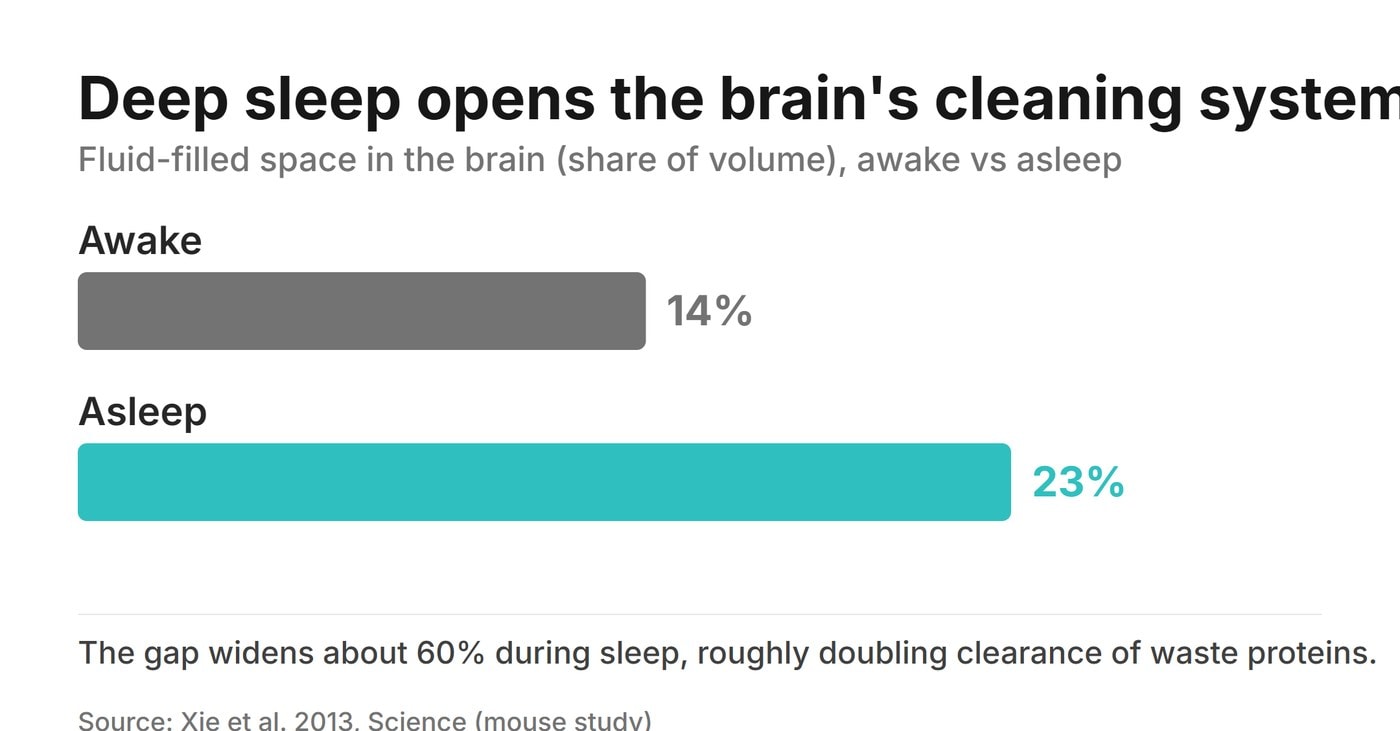
Maiken Nedergaard’s team at the University of Rochester used two-photon imaging in live mice to watch the brain during sleep in real time. What they observed was striking. During natural sleep, the interstitial space between neurons , the gaps between brain cells , expanded by approximately 60 percent. Not a subtle change. The cells physically contracted, opening channels that flooded the brain with cerebrospinal fluid.
This cerebrospinal fluid wasn’t just passively circulating. It was actively flushing interstitial waste , metabolic debris, misfolded proteins, the molecular byproducts of a day’s worth of neuronal activity. Among the waste being cleared: beta-amyloid (Aβ), the protein whose accumulation is the defining pathological hallmark of Alzheimer’s disease.
Nedergaard named this the glymphatic system , a play on “glial” (the cells that shrink to create the channels) and “lymphatic” (the body’s waste-removal system, which the brain lacks). The brain, uniquely among organs, has no conventional lymphatic vessels. The glymphatic system is its substitute. And it operates almost exclusively during sleep.
The parallel that makes this real: imagine your kitchen. You cook all day , every burner active, counters covered in prep scraps, splatter on the stovetop, flour on the floor. The cleaning crew comes at midnight, but only if you leave the kitchen. If you stay , if you keep the lights on, keep working, keep producing , the mess accumulates. One skipped night is recoverable. A year of skipped nights, and the kitchen is a health hazard. A decade of skipped nights, and you’ve got a problem no amount of cleaning can reverse.
That’s not metaphor. That’s the Nedergaard group’s subsequent finding, published in Science in 2020: glymphatic failure may represent a final common pathway to dementia. The waste that doesn’t get cleared during sleep is the waste that, over years, aggregates into the plaques and tangles that define neurodegenerative disease.
What are the stages of sleep?
Not all sleep is created equal. Your brain cycles through distinct stages approximately every 90 minutes, and each stage performs different functions. Understanding this architecture , and what disrupts it , is the difference between sleeping and actually recovering.
The critical insight from the hypnogram above: deep sleep and REM sleep are distributed asymmetrically across the night. The majority of deep sleep (N3) occurs in the first half. The majority of REM sleep occurs in the second half. This has a direct practical implication: if you go to bed at 1 AM instead of 11 PM, you don’t just get “less sleep.” You get disproportionately less deep sleep , the stage when glymphatic clearance peaks, when growth hormone is released, and when physical restoration primarily occurs.
Meanwhile, if you cut sleep short by waking at 5 AM instead of 7 AM, you lose disproportionately more REM sleep , the stage critical for emotional regulation, memory consolidation, and creative problem-solving. Both ends of the night do different things. You can’t trade one for the other.
Sleep architecture is governed by circadian timing, not accumulated debt. Sleeping 10 hours on Saturday doesn’t reconstruct the deep sleep you lost on Wednesday night. The specific stages of sleep are tied to specific times of night, driven by your circadian clock and homeostatic sleep pressure. You can partially recover REM sleep after deprivation (your brain will prioritize it), but deep sleep loss is harder to reclaim. The most effective strategy isn’t recovery , it’s consistency. Same bedtime, same wake time, seven days a week.
How does deep sleep clean the brain?
Now we can return to the glymphatic system with the architectural context to understand why it matters so much. The waste clearance that Xie et al. documented doesn’t happen uniformly across all sleep stages. It happens primarily during deep NREM sleep , specifically the slow-wave oscillations of Stage N3.
What you already knew: “Sleep is important for the brain.” Vaguely. As a general health principle.
What the science adds: During deep sleep, glial cells physically shrink by roughly 60%, creating an expanded network of channels between neurons. Cerebrospinal fluid then surges through these channels in a pulsing, convective flow , entering along arteries, exchanging with interstitial fluid, and exiting along veins. This flow carries away β-amyloid, tau proteins, and other metabolic waste at approximately twice the rate measured during wakefulness. The system depends on aquaporin-4 water channels on glial cell membranes. Deleting these channels in mice reduces waste clearance by about 55 to 65%, depending on the marker.
The new understanding: Your brain doesn’t just “rest” during sleep. It runs a plumbing operation that physically cannot execute while you’re awake. Every night of poor sleep or short sleep is a missed cleaning cycle. The debris accumulates. And the specific debris that accumulates , β-amyloid, tau , is the same debris that, over decades, defines Alzheimer’s disease. Nedergaard and Goldman’s 2020 paper in Science argued that glymphatic failure may represent a common final pathway in neurodegeneration. You are not sleeping to rest. You are sleeping to wash your brain.
The connection to the previous articles in this library is direct. In our fasting article, we described how autophagy , cellular self-cleaning , activates during periods of nutrient deprivation. Autophagy handles intracellular waste: damaged proteins and organelles inside cells. The glymphatic system handles extracellular waste: debris floating between cells. Fasting cleans inside the cell. Sleep cleans outside it. They are complementary systems, both activated by states of reduced activity, both critical for long-term health, and both chronically underused in modern life.
How does body temperature affect sleep?
Here is where the science becomes immediately practical , and where it connects directly to cold exposure.
Your core body temperature follows a circadian rhythm, peaking in the late afternoon and dropping by 1-2°F (0.5-1°C) as sleep approaches. This decline is not a side effect of sleep. It is a trigger. Harding, Franks, and Wisden’s 2019 review in Frontiers in Neuroscience made this relationship explicit: in mammals, sleep onset and core temperature reduction occur together, and the decline in temperature actively promotes the initiation of NREM sleep.
What you already knew: “A cool room helps you sleep.” As a general tip from wellness articles.
What the science adds: The mechanism is specific. Sleep onset requires peripheral vasodilation , blood vessels in your hands and feet open up, radiating heat away from your core. This heat dump at the extremities is what drives the core temperature decline that triggers NREM sleep. Kräuchi’s research showed that the rate of distal vasodilation (warming of the hands and feet) is the single best physiological predictor of how quickly you’ll fall asleep , better than any subjective measure of sleepiness. Direct skin warming in humans shortens sleep latency and promotes NREM sleep.
The new understanding: Your body uses temperature as the master switch for sleep initiation. The cool room helps , but not because cold is directly sleep-promoting. It helps because a cool environment makes it easier for your body to dump core heat through the extremities. The real trigger is the decline in core temperature. Anything that amplifies that decline accelerates sleep onset and deepens NREM sleep. And this is where cold exposure enters the picture in a way most people haven’t considered.
Do ice baths help you sleep better?
Cold water immersion causes rapid peripheral vasoconstriction , blood rushes from the extremities to protect the core. Your core temperature initially holds steady or even rises slightly. But after you exit the cold, something counterintuitive happens: your body overcorrects. Blood vessels in the extremities dilate aggressively. Heat pours outward. Core temperature begins to drop , not to its starting point, but below it.
This rebound effect , vasoconstriction followed by vasodilation, core warming followed by core cooling , produces a thermal signature that mirrors almost exactly the pattern your body needs to initiate deep sleep. The cold plunge essentially pre-loads the thermoregulatory cascade that your body performs naturally at bedtime, amplifying the core temperature decline and promoting faster sleep onset and more time in deep NREM sleep.
The cold plunge must happen early enough for the rebound to complete before bed. A plunge at 4-6 PM with a 10-11 PM bedtime gives the body 4-6 hours for the full vasoconstriction → vasodilation → core cooling cycle. A plunge immediately before bed does the opposite , the acute vasoconstriction and norepinephrine surge will delay sleep onset and fragment early sleep. Timing is not optional. It is the mechanism.
This is the bridge between our cold exposure articles and sleep science: a well-timed cold plunge isn’t just a recovery tool. It’s a sleep-architecture tool. By pre-loading the thermal decline, you’re not forcing sleep , you’re giving your thermostat the signal it’s been waiting for, in a language it already understands.
What happens when you don’t get enough deep sleep?
The consequences of chronic sleep disruption are not subtle, and they extend far beyond feeling tired. Matthew Walker’s synthesis of the sleep research literature paints a picture that is, frankly, alarming in its scope.
Cognitive performance. After 17-19 hours of sustained wakefulness, cognitive and motor performance degrades to levels comparable to a blood alcohol concentration of 0.05%. After 24 hours, it matches 0.10% , legally drunk. But here’s what makes sleep deprivation more insidious than alcohol: intoxicated people know they’re impaired. Sleep-deprived people do not. Subjective sleepiness plateaus after a few days, even as objective performance continues to decline.
Immune function. A single night of four hours’ sleep reduces natural killer cell activity sharply (about 70% in Walker’s synthesis of Irwin’s 1996 data). These are the immune cells responsible for surveilling and destroying cancer cells and virus-infected cells. Sleep is not a luxury that supports immune function. Sleep is immune function.
Metabolic health. Restricting sleep to four hours for just six nights creates a pre-diabetic glucose profile in otherwise healthy young adults. Insulin sensitivity drops. Leptin (the satiety hormone) falls. Ghrelin (the hunger hormone) rises. The body begins metabolically behaving as though it is in danger , because, from an evolutionary perspective, sustained wakefulness means something has gone badly wrong.
Emotional regulation. The amygdala , the brain’s threat-detection center , becomes 60% more reactive after sleep deprivation, while the prefrontal cortex (which modulates emotional responses) becomes disconnected from it. The result: amplified emotional reactions with diminished capacity to regulate them. This isn’t weakness. It’s architecture , the infrastructure for emotional stability requires sleep to maintain.
These aren’t effects that require extreme deprivation. Restricting sleep to six hours per night , a duration many ambitious people consider adequate , produces measurable cognitive impairment within two weeks equivalent to going 48 hours without sleep. The most dangerous aspect: the subjects in these studies consistently rated their alertness as acceptable. They had no subjective awareness of how impaired they had become. You cannot feel the cognitive damage from chronic moderate sleep restriction. You can only measure it.
How to improve your deep sleep
Sleep optimization is not a single intervention. It’s an environment, a schedule, and a set of behaviors that align with the neuroscience of how sleep is initiated and maintained. Every recommendation below derives from the mechanisms described in the preceding sections , temperature regulation, circadian timing, and the conditions required for deep NREM and REM sleep.
Notice what isn’t on this list: sleep supplements, sleep apps, sleep-tracking obsession. The protocol above addresses the root mechanisms , temperature, light, timing, and circadian consistency. These are the inputs your biology actually responds to. Everything else is noise.
Sleep is the single most effective thing you can do to reset your brain and body health each day , Mother Nature’s best effort yet at contra-death.
Every article in this library converges on the same principle: your body has ancient, sophisticated maintenance systems that modern life systematically prevents from running. Cold exposure activates cellular stress responses. Fasting activates intracellular recycling. Sleep activates the brain’s only waste-clearance system. These are not separate interventions. They are different entry points into the same biological truth , that restoration requires the absence of stimulation.
The cold plunge pre-loads your thermostat. The compressed eating window gives your cells time to clean internally. And consistent, sufficient sleep gives your brain time to wash itself in a way that no waking activity can replicate. You don’t need to do all three perfectly. But understanding that they share the same underlying logic , that the pause is the signal , changes how you approach all of them.
Tonight, go to bed on time. Turn off the lights. Let the kitchen close. Your brain knows what to do next. It’s been waiting.
| Step | What to do | Why it works |
|---|---|---|
| Fix your bedtime | Hold a consistent time within 30 min, 7 days a week | Deep sleep is front-loaded, so a stable clock protects most of it |
| Cool the room | 18 to 20°C (65 to 68°F) | A cool room lets core temperature fall, which triggers deep sleep |
| Morning light | Bright outdoor light within about an hour of waking | Anchors your body clock and strengthens night-time sleep drive |
| Caffeine cutoff | Last coffee by early afternoon | With a 5 to 6 hour half-life, a 2pm coffee still has roughly a third active at 10pm |
| Wind down warm | A warm shower or bath 1 to 2 hours before bed | The rebound temperature drop shortens sleep onset by about 10 minutes |
| Time cold earlier | Keep intense cold to earlier in the day, not the last hour before bed | Cold is alerting; use it to support the evening decline, not to fight it |
Frequently asked questions
Does cold exposure improve deep sleep?
A drop in core temperature helps trigger deep sleep, and cold exposure a few hours before bed plausibly supports the evening temperature decline. But no controlled trial has shown that a specific pre-bed plunge measurably increases deep sleep, so treat it as a reasonable aid rather than a proven switch. Avoid intense cold in the last hour before bed, which is alerting.
What is the best bedroom temperature for sleep?
Around 18 to 20°C (65 to 68°F). A cool room helps your body shed heat, which supports both falling asleep and deeper slow-wave sleep.
Why is deep sleep so important?
Deep, slow-wave sleep is when the brain’s glymphatic system clears metabolic waste and the body does much of its physical repair. The brain’s fluid space expands about 60% during sleep, roughly doubling the clearance of waste proteins (Xie et al. 2013).
When in the night do you get most of your deep sleep?
Deep sleep is front-loaded into the first half of the night. That is why a consistent bedtime and protecting your first few hours of sleep protects most of your slow-wave sleep.
Does a warm bath before bed help you sleep?
Yes. A warm bath 1 to 2 hours before bed triggers a rebound drop in core temperature that shortens sleep onset by about 10 minutes on average (Haghayegh et al. 2019).
Cool sleep in a tropical climate
Singapore’s year-round warmth works against the evening temperature drop your brain uses to fall asleep. A cool bedroom is step one; some people also use a short, controlled cool-down a few hours before bed to nudge the decline along. The Vitalis 3 holds any set point from 2 to 40°C, so that cool-down is a dial away, not a bag of ice.
- Xie L, Kang H, Xu Q, et al. (2013). Sleep drives metabolite clearance from the adult brain. Science 342(6156):373-377. doi.org/10.1126/science.1241224
- Nedergaard M, Goldman SA (2020). Glymphatic failure as a final common pathway to dementia. Science 370(6512):50-56. doi.org/10.1126/science.abb8739
- Iliff JJ, Wang M, Liao Y, et al. (2012). A paravascular pathway facilitates CSF flow and clearance of interstitial solutes. Science Translational Medicine 4(147):147ra111. doi.org/10.1126/scitranslmed.3003748
- Kräuchi K, Cajochen C, Werth E, Wirz-Justice A (2000). Functional link between distal vasodilation and sleep-onset latency? Am J Physiol Regul Integr Comp Physiol 278(3):R741-R748. doi.org/10.1152/ajpregu.2000.278.3.R741
- Harding EC, Franks NP, Wisden W (2019). The temperature dependence of sleep. Frontiers in Neuroscience 13:336. doi.org/10.3389/fnins.2019.00336
- Haghayegh S, Khoshnevis S, Smolensky MH, et al. (2019). Before-bedtime passive body heating and sleep. Sleep Medicine Reviews 46:124-135. doi.org/10.1016/j.smrv.2019.04.008
- Williamson AM, Feyer AM (2000). Moderate sleep deprivation produces impairments equivalent to alcohol intoxication. Occup Environ Med 57(10):649-655. doi.org/10.1136/oem.57.10.649
- Yoo SS, Gujar N, Hu P, Jolesz FA, Walker MP (2007). The human emotional brain without sleep: a prefrontal amygdala disconnect. Current Biology 17(20):R877-R878. doi.org/10.1016/j.cub.2007.08.007
- Irwin M, McClintick J, Costlow C, et al. (1996). Partial night sleep deprivation reduces natural killer and cellular immune responses in humans. FASEB Journal 10(5):643-653. doi.org/10.1096/fasebj.10.5.8621064
- Spiegel K, Leproult R, Van Cauter E (1999). Impact of sleep debt on metabolic and endocrine function. The Lancet 354(9188):1435-1439. doi.org/10.1016/S0140-6736(99)01376-8
- Van Dongen HPA, Maislin G, Mullington JM, Dinges DF (2003). The cumulative cost of additional wakefulness. Sleep 26(2):117-126. doi.org/10.1093/sleep/26.2.117