The Ice Bath Buyer’s Guide for Singapore
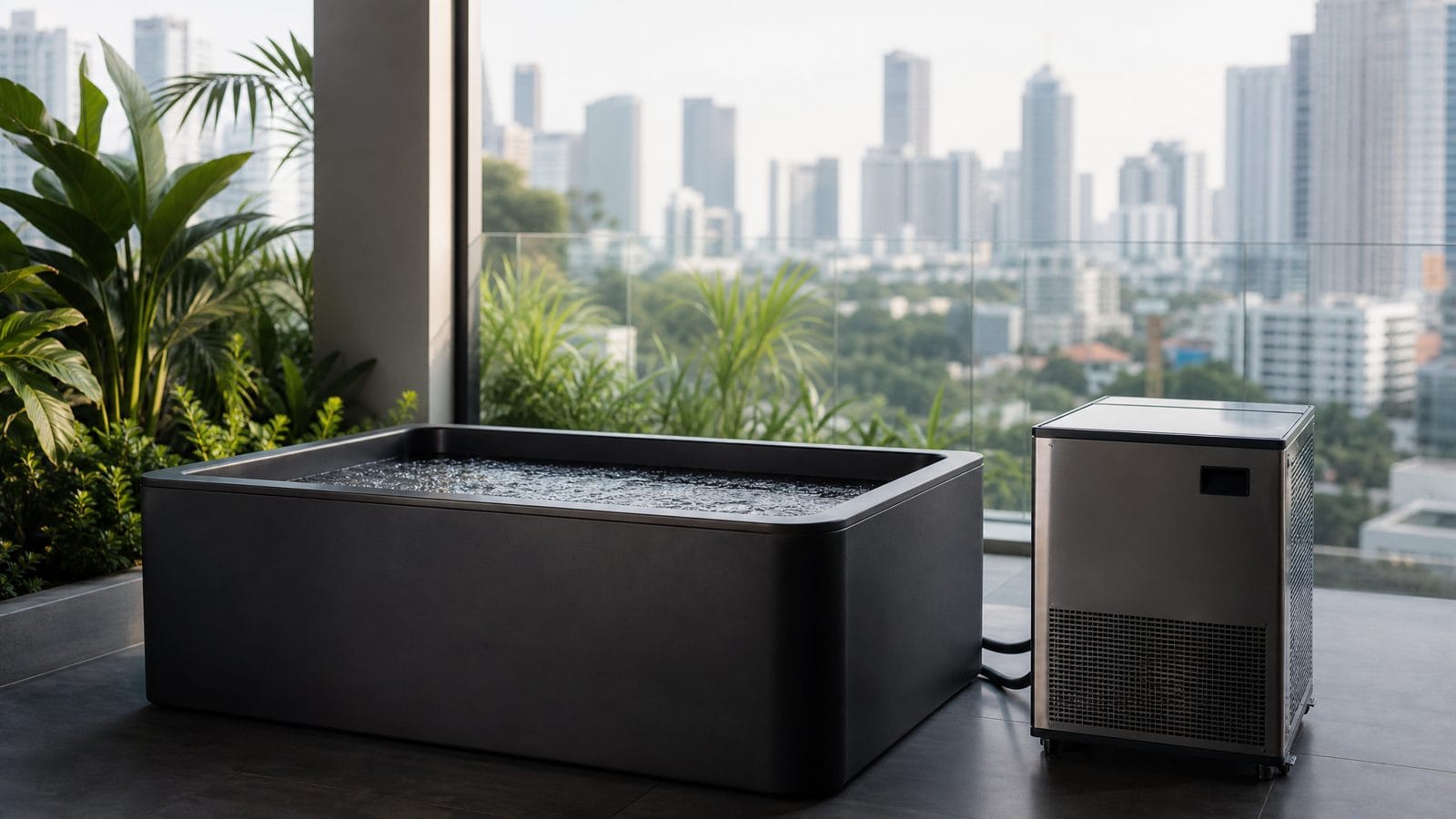
Buying an ice bath in Singapore is a different problem from buying one in Texas. Here the air sits above 30°C for much of the day, the tap runs warm year-round, most homes are HDB flats with real floor limits, and the wall socket is 230 V. Those four facts change which unit is right for you, where it can go, and what it costs to run. This guide walks the decision the way a careful buyer would, from chiller power to floor loading to the fine print on warranty, so you finish knowing exactly what to look for.
The short answer
For a home ice bath you will use daily in Singapore, budget roughly S$5,000 to S$10,500 for a chiller-based system, or S$100 to S$2,000 for a plain tub you cool with ice. The chiller is the real product here, so prioritise cooling power for the tropical heat, ozone-plus-filtration sanitation over UV alone, genuine insulation, and running noise under about 60 dB. Check that the electricals carry a SAFETY Mark and a 230 V plug, and insist on a written local warranty and service. Running costs are small: a few dollars a week of electricity, and about a dollar for a full water change. If you live in an HDB flat, plan the placement around floor loading before you buy, not after.
In this article
- What should I look for when buying an ice bath in Singapore?
- How powerful does the chiller need to be for Singapore’s heat?
- How do you keep the water clean, and how often do you change it?
- How much does an ice bath cost to run in Singapore?
- How much does an ice bath cost to buy in Singapore?
- Will an ice bath work in an HDB flat or condo?
- What warranty, safety, and service should you expect?
What should I look for when buying an ice bath in Singapore?
Every serious buyer’s guide converges on the same handful of criteria, but the weighting changes in the tropics. In a cool country you can get away with a weak chiller and thin walls. In Singapore, where the machine fights warm air and warm tap water all day, the chiller and the insulation carry the whole system. Here is the shortlist, with what good looks like and why it matters locally. The rest of this guide unpacks each row.
| What to check | What good looks like | Why it matters in Singapore |
|---|---|---|
| Cooling power | Enough capacity to hold your set point and recover between sessions | Chillers here fight 30°C+ air and warm tap water year-round |
| Temperature range | A stable set point you choose, roughly 2 to 40°C | You want a real cold hold, not “as cold as the ice lasts” |
| Sanitation | Ozone plus a fine filter, not UV alone | Warm water fouls faster, so a real system stretches changes to weeks |
| Insulation | Insulated walls and a fitted cover | Insulation, not chiller size, keeps the compressor and the bill down |
| Noise | Ideally under about 60 dB when running | Party walls and night sessions in HDB and condo living |
| Electrical safety | SAFETY Mark and a 230 V, 3-pin BS 1363 plug | Grey imports are often built for 110 V US sockets |
| Footprint and weight | Fits your space and your floor limit when filled | 300 L of water is 300 kg over about one square metre |
| Warranty and service | A written term and a local service team | A warranty you can actually claim, with delivery here |
How powerful does the chiller need to be for Singapore’s heat?
In Singapore the chiller is the product and the tub is just where you sit. Afternoons here routinely climb above 32°C, which the national weather service describes plainly: hot afternoons with maximum temperature above 32°C are common. Tap water arrives warm too, so the same chiller that would coast in London has to work hard here. That makes headroom the single most important sizing decision. Undersized units cannot recover between sessions and, as chiller specialists put it, they cannot recover and will burn out quickly.
As a rough guide, cooling about 570 litres of water from roughly 21°C down to 4°C takes about 4 to 6 hours on a 1/3 HP chiller, 2 to 3 hours on 1/2 HP, and under 2 hours on 3/4 HP and up. Those are temperate-climate figures. In Singapore’s heat, plan for the high end of each range, which is exactly why cold-plunge guides tell hot-climate buyers to size up. Beyond roughly 0.8 to 1 HP, extra power mostly buys faster pulldown rather than a better hold: one local seller notes that once the water is at temperature, a 1 HP chiller offers little advantage over a 0.8 HP unit. For a system engineered around tropical duty, see the Vitalis 3 ice bath specifications.
How do you keep the water clean, and how often do you change it?
Cold water left standing grows bacteria and biofilm, so sanitation is not optional, and it is where cheap systems cut corners. Two approaches dominate. Ozone is a powerful oxidiser: industry sources report it can be up to 100 times more effective than chlorine at destroying bacteria, viruses, and biofilm. Ultraviolet works too, but only on the water actually passing through its chamber, so it depends on continuous circulation. Pair either with a filter around 20 microns, the sweet spot that catches debris without choking flow. The weak point of budget units is relying on UV alone.
Sanitation decides how often you drain and refill. Filter-only tubs need frequent changes: for one popular model, the reviewer notes the maker recommends changing the water every 3 to 5 days. A proper ozone-plus-filtration system stretches that to weeks. And a full change is cheap in Singapore anyway, on the order of a dollar, which we cost out in the next section. For the full routine, see our guide on how often to change your ice bath water.
How much does an ice bath cost to run in Singapore?
Two costs run a home ice bath: electricity and water. Electricity is the one that moves. Singapore’s household tariff rose 17.0% for the July to September 2026 quarter, reaching 34.78 cents per kWh including GST, a record high. At that rate, every 100 W of continuous draw costs about S$0.83 a day (0.1 kW x 24 h x $0.3478). How much your unit actually draws depends on insulation: once the water is at temperature, a well-sealed, covered tub lets the compressor rest for long stretches instead of running flat out, which keeps the daily figure closer to that 100 W benchmark than to the compressor’s full rated draw.
Water is almost a rounding error. Potable water in Singapore is $3.24 per cubic metre before GST for the first tier, so a full 300-litre change works out to about S$1 including GST. The real lever on your bill is insulation. Bare steel and thin walls bleed cold, so specialists advise you to prioritise insulated walls or covers to keep the cold in. Insulation, not chiller size, is what keeps the daily cost down, because a well-sealed tub lets the compressor rest instead of running flat out.
How much does an ice bath cost to buy in Singapore?
Home setups fall into a clear ladder. A basic portable tub with no chiller runs about S$100 to S$500, and an insulated tub without a chiller about S$500 to S$2,000. Both rely on ice or on the weather, which in Singapore means an endless ice habit. Add a chiller and you reach the range most daily users actually buy: a chiller alone starts around S$3,990, an inflatable tub plus chiller runs about S$5,000 to S$6,500, and an integrated solid plunge about S$6,500 to S$10,500 and up.
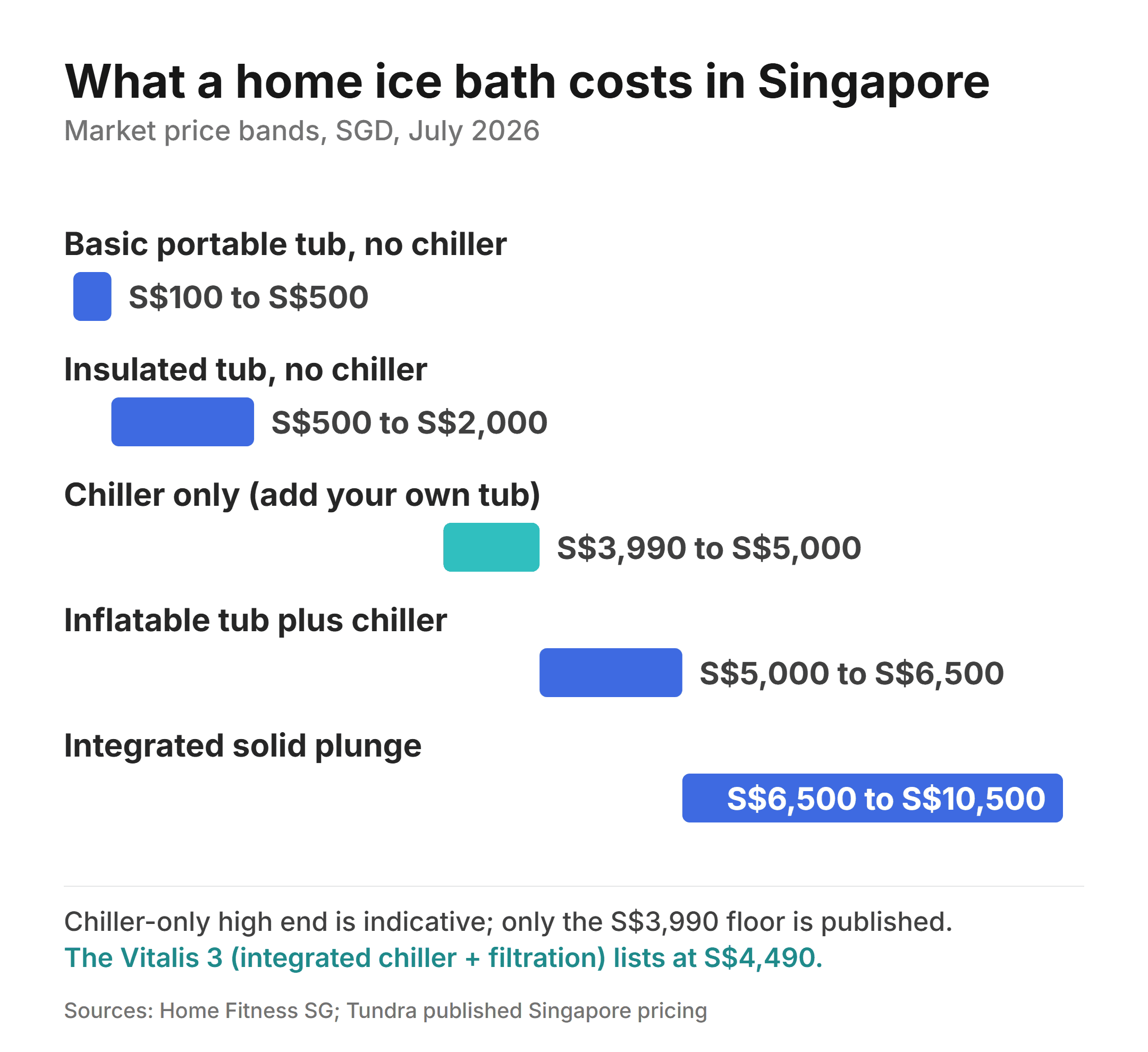
Where does a Cool Bionic unit sit? The Vitalis 3 lists at S$4,490, which places it below the typical inflatable-plus-chiller band while being an integrated system engineered for the heat rather than a tub with a box bolted on. Price is only part of the calculation, though. Buying from a local brand also means delivery and commissioning, a warranty you can actually claim, and a service team that can come to you, none of which a cheaper grey import can match once something goes wrong.
Will an ice bath work in an HDB flat or condo?
The thing nobody tells Singapore buyers: water is heavy. Water weighs one kilogram per litre, or about 8.34 pounds per gallon, so a 300-litre bath holds 300 kg of water before you add the tub, the chiller, and yourself. HDB renovation guidelines cap floor loads at 150 kilograms per square metre, and a filled plunge over a footprint of roughly one square metre can exceed that as a concentrated load. This is a renovation guideline about distributed weight, not an outright ban, so the sensible moves are to spread the load with a base board, favour a ground-floor patio, service yard, or reinforced balcony over a bedroom floor, and check with HDB or a professional engineer before any permanent install.
Two more placement realities. Drainage: site the tub near a floor trap so emptying is not a bucket job. Noise: chillers run on compressors, typically between 50 decibels, about as loud as a refrigerator, and 65 decibels, about an air conditioner, measured up close. In a flat with party walls and neighbours a metre away, aim for the quiet end of that range and run the noisy pulldown during the day rather than at 2 a.m.
What warranty, safety, and service should you expect?
A chiller is an electrical appliance running unattended next to water, so the electricals matter more than the marketing. Singapore regulates 33 categories of household electrical and gas appliances as Controlled Goods, and the SAFETY Mark must be affixed on Controlled Goods that have been tested and certified before they can be supplied in Singapore. Consumers are strongly advised to buy only Controlled Goods that carry a valid SAFETY Mark. Just as important, Singapore runs on 230 V, 50 Hz with 3-pin BS 1363 plugs, while many imported chillers are built for 110 V US sockets. Insist on a compliant plug and mains setup, and never daisy-chain travel adaptors near water.
Warranty is where buying local becomes concrete rather than a slogan. Ask for the term in writing before you pay. Cool Bionic covers the Vitalis 3 for 12 months as standard, with a free extension to 18 months when you register, and delivers standard items in 1 to 3 working days. That matters because a chiller is a serviceable machine, and the Vitalis ice bath for Singapore homes is backed by a local team rather than an overseas email address. A warranty you cannot practically claim, on a unit no one here can service, is not really a warranty at all.
Frequently asked questions
How much does an ice bath cost in Singapore?
A daily-use setup with a chiller typically runs about S$5,000 to S$10,500, depending on whether you choose an inflatable tub plus chiller or an integrated plunge. Chiller-only upgrades start around S$3,990, and a basic tub with no chiller can cost as little as S$100 to S$500. The Vitalis 3 lists at S$4,490.
Do ice baths use a lot of electricity?
Less than most people fear, though it depends on insulation. At the current Singapore tariff of 34.78 cents per kWh, every 100 W of continuous draw is about S$0.83 a day. A well-insulated plunge lets the compressor rest once the water is at temperature, so its average draw stays low. A poorly insulated tub whose compressor runs constantly costs far more, which is why insulation is the criterion that quietly decides your bill.
How often do you change ice bath water?
With a proper ozone-plus-filtration system, every few weeks rather than every few days. Filter-only tubs need changing far more often, sometimes every 3 to 5 days. A full change of about 300 litres costs only around a dollar in Singapore, so there is little reason to stretch the water past when it looks or smells off.
Can I put an ice bath on my HDB balcony?
Often yes, but check the weight first. A 300-litre bath holds 300 kg of water alone, and HDB renovation guidelines cap floor loads at 150 kilograms per square metre. Spread the load with a base board, favour a service yard, patio, or reinforced balcony, and consult HDB or a professional engineer for a permanent installation.
How cold should an ice bath be?
Most people in the local market start around 10 to 15°C for 2 to 5 minutes, a few times a week, then adjust colder and longer with experience. For a full breakdown of temperature and timing, see our guide on what temperature your ice bath should be.
Do I need to add ice?
No. A chiller-based system cools and holds the water electrically, so you never buy or haul ice. That is the main reason a chiller earns its cost in Singapore, where ice in an uninsulated tub melts fast in the heat and warm tap water offers no help.
One system, built for the tropics
Most of what makes an ice bath worth owning in Singapore comes down to the chiller, the insulation, and a service team you can actually reach. The Vitalis 3 is built around those, holding any set point from 2 to 40°C against 30°C air, so the water is exactly as cold as you chose and no colder.
- Tundra. Ice Bath & Cold Plunge Buyer’s Guide (Singapore). tundra.health
- Home Fitness Singapore. Buy Ice Baths in Singapore and Best Cold Plunge Centers. homefitness.com.sg
- SP Group. Electricity Tariff Revision for the Period 1 July to 30 September 2026. spgroup.com.sg
- Sunollo. Singapore Electricity Price Tracker. sunollo.com
- The Money Bees. Water Bill Price Increase (Singapore). themoneybees.co
- Consumer Product Safety Office, Enterprise Singapore. Look for the SAFETY Mark. consumerproductsafety.gov.sg
- Home & Decor. Renovation Guidelines for HDB Flats in Singapore. homeanddecor.com.sg
- Plunge Junkies. Water Chiller Buying Guide. plungejunkies.com
- Sun Home Saunas. Cold Plunge Filtration. sunhomesaunas.com
- Icebound Essentials. Cold Plunge Buying Guide. iceboundessentials.com
- Garage Gym Reviews. Best Cold Plunge Tubs (2026). garagegymreviews.com
- Hydragun. The Ultimate Cold Plunge & Ice Bath Guide. hydragun.sg
- Meteorological Service Singapore. Climate of Singapore. weather.gov.sg