What an Ice Bath Really Costs to Run in Singapore
On 1 July 2026, SP Group raised Singapore’s household electricity tariff by 17.0 percent, to 31.91 cents per kWh before GST. Nearly every ice bath cost guide online was written before that happened, and most were written for foreign electricity prices and mild weather anyway. So here is the maths that actually applies to you: the current SP Group tariff, PUB water prices, a real Singapore ice supplier’s price list, and duty cycles that assume tropical afternoons, because that is what your chiller works against.
The short answer
A well-insulated, filtered ice bath running daily in Singapore costs about S$16 to S$50 a month in electricity at the current tariff of 34.78 cents per kWh with GST, plus about a dollar each time you change the water. A barrel-and-bagged-ice setup costs roughly S$45 to S$70 per cold session, because tropical tap water starts near 29°C and each session needs 4 to 6 large bags of ice. Over a month of daily use, that is about S$35 to S$40 for the chiller route against S$1,450 to S$2,050 for ice: roughly 40 times cheaper to operate. The water itself is a rounding error at about S$1.06 per 300-litre refill.
| Monthly cost at daily use | Insulated + filtered chiller | Barrel + bagged ice |
|---|---|---|
| Electricity | ~S$31 (mid band) | S$0 |
| Ice (30 sessions) | S$0 | ~S$1,400-2,000 |
| Water changes | ~S$0.35-0.53 | ~S$16-32 |
| Filters and sanitiser | a few dollars | S$0 |
| Indicative total | ~S$35-40 | ~S$1,450-2,050 |
In this article
- How much electricity does a cold plunge chiller use in Singapore?
- What is Singapore’s electricity tariff right now?
- How much does the water itself cost?
- How much does a bagged-ice ice bath cost per session?
- Chiller or barrel and ice: which is cheaper over a month?
- How can I cut my ice bath’s running cost?
How much electricity does a cold plunge chiller use in Singapore?
A cold plunge chiller is essentially a small, hard-working compressor. A typical mid-size unit draws between 200 and 1,000 watts while it is actively cooling, and a 1HP chiller consumes approximately 1 kWh of electricity per hour to cool 100 litres of water. The saving grace is that it does not run all day: once the water reaches your set temperature, chillers cycle on and off, so what you actually pay for is total run time, not rated power.
In daily-energy terms, the most careful generic estimate puts a mid-size setup at about 1.5 to 4 kWh per day. The worst case is well defined too: a 1HP chiller holding 200 litres at 3°C around the clock uses about 4.8 kWh a day.
Those numbers come from temperate-climate sources, and here Singapore needs an honest adjustment. Ambient temperature is the single biggest driver of run time: the same source notes that a unit in a 35°C garage runs far more than one in a cool basement. Singapore is that hot garage all year: the island’s 24-hour mean temperature runs 26.8 to 28.6°C, with daytime highs of 31 to 33°C, and there is no cool season to give your compressor a break. So treat the low end of the band as an indoor, insulated best case, and plan on the upper half for an outdoor setup.
Convert that to money at the current tariff of 34.78 cents per kWh with GST and you get, by our model: about S$15.65 a month at 1.5 kWh a day (insulated tub with a lid), about S$31.30 at 3 kWh a day (a typical setup), and about S$50.08 at the always-on 4.8 kWh worst case.
Our own operating data sits inside that band. The Vitalis 3 pairs a 1 kW rated-input chiller (3 kW of cooling capacity) with a 300-litre insulated tub, and in daily use with the lid on, about 2.5 hours of compressor runtime a day is enough to hold the water cold: roughly 75 kWh a month, or about S$26.09 at the current tariff. The filtration loop circulates around the clock; only the compressor cycles. From a warm 28°C fill, it pulls 300 litres down to 15°C in about 150 minutes, using roughly 2.5 kWh.
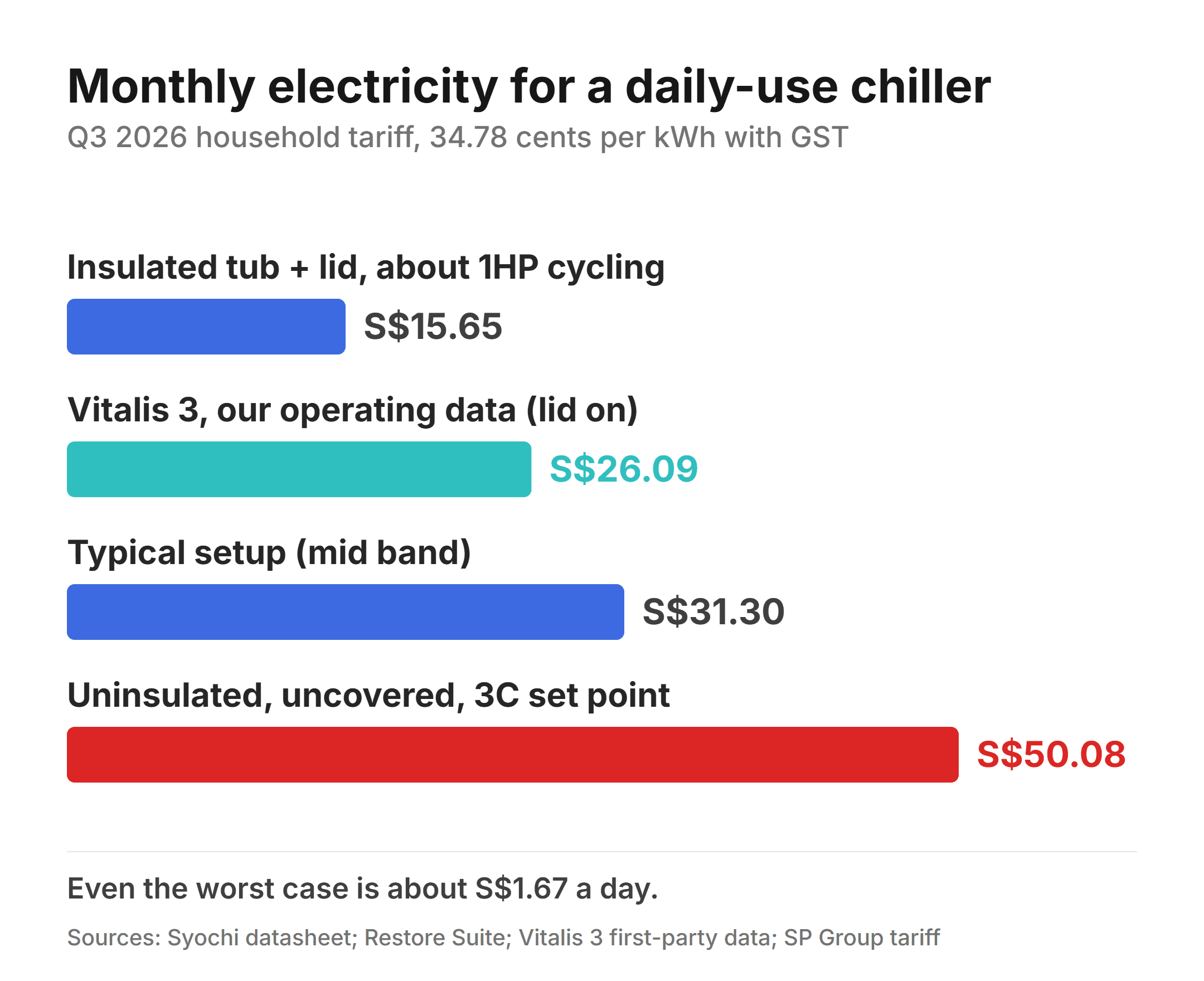
Even the worst case works out to about S$1.67 a day, less than a kopitiam lunch.
What is Singapore’s electricity tariff right now?
For 1 July to 30 September 2026, SP Group’s regulated household tariff is 31.91 cents per kWh before GST, or 34.78 cents per kWh with GST. That is the number every calculation in this article uses. It arrived with a jolt: the quarter’s revision raised household tariffs by 17.0 percent, or 4.64 cents per kWh, and SP Group estimates the average four-room HDB household’s monthly bill rises by S$17.14 before GST.
That last figure is useful perspective. Run a well-insulated ice bath every single day and its entire monthly electricity bill, about S$16, is less than what the July hike alone added to the average flat’s bill. The tariff resets every quarter, so any cost article without a quarter stamp is guesswork; this one is stamped Q3 2026, and we redo the maths when SP Group moves the rate.
How much does the water itself cost?
Almost nothing, and it is worth seeing why. PUB’s household potable water price is S$3.24 per cubic metre before GST for the first 40 cubic metres a month, which bundles the S$1.43 water tariff, a water conservation tax at 50 percent of the tariff, and a S$1.09 waterborne tax.
A 300-litre tub holds 0.3 cubic metres. A full refill therefore costs about S$0.97 before GST, or about S$1.06 with 9 percent GST. You could change the water every week for a year and spend less than S$60.
What changes is frequency. With filtration and sanitation, water can last 8 to 12 weeks between full changes, which puts a filtered system’s water bill at well under a dollar a month. An unfiltered barrel needs draining every session or two, roughly S$16 to S$32 a month at daily use. Still small, but the real cost of skipping filtration shows up in the ice, below. For the full regimen, see our guide on how often to change ice bath water.
How much does a bagged-ice ice bath cost per session?
The bagged-ice route has a problem specific to Singapore: your starting point. With a 24-hour mean temperature of 26.8 to 28.6°C, tap water here arrives warm, close to 29°C. Overseas guides quietly assume cool tap water doing half the work. In Singapore, the ice does all of it.
The standard rule of thumb is one part ice to three parts water by volume, and the same source advises planning 30 to 50 percent more ice than baseline in hot weather. For a 300-litre barrel going from about 29°C to a genuinely cold 15°C, that lands around 75 to 100 kg of ice per session, or 4 to 6 of the standard 18 kg bags.
Real local pricing: Tuck Lee Ice, a long-established supplier out of Defu Lane, sells 18 kg tube ice at two bags for S$20, which is S$10 a bag or about 56 cents per kilogram, with a S$10 delivery fee on orders under S$100. Stack it up: S$40 to S$60 of ice, about S$1.06 of water, and S$0 to S$10 of delivery. Each cold session in a barrel costs roughly S$45 to S$70.
If that sounds high, the overseas maths agrees directionally. A US cost calculator that assumes 9 to 27 kg of ice per session puts an ice-only user at about USD 208 a month at four sessions a week, and that is with cheaper ice and cooler tap water than Singapore has.
Chiller or barrel and ice: which is cheaper over a month?
Put the two side by side at daily use and the gap is not close. The chiller route: about S$31 of electricity at the mid band, under a dollar of water, and a few dollars of consumables, call it S$35 to S$40 all-in. The barrel route: 30 sessions of bagged ice at S$45 to S$70 each is roughly S$1,400 to S$2,000 of ice, plus S$16 to S$32 of water changes, for an indicative S$1,450 to S$2,050 a month.
At Singapore ice prices, a chilled system is roughly 40 times cheaper to operate than a barrel and bagged ice. Even a modest three-sessions-a-week habit puts the barrel route at roughly S$580 to S$910 a month, still an order of magnitude above the chiller.
Two design choices drive the chiller’s low number. Insulation: a well-insulated tub with a good lid can roughly halve the chiller’s run time, which is why an insulated, filtered system like the Vitalis 3 sits at the low end of the electricity band rather than the 4.8 kWh worst case. And filtration, which is what stretches water changes to weeks instead of sessions. Consumables for a filtered system, meaning replacement filters, sanitiser, and test strips, run roughly USD 30 to 80 a year, a few dollars a month in Singapore terms.
Run the payback by our model and the conclusion is blunt: at daily use, the S$1,400 or more a month you are not spending on ice covers the Vitalis 3’s S$4,490 price in just over three months. At three sessions a week, five to eight months. After that, the running cost of daily cold in Singapore is about a dollar a day.
How can I cut my ice bath’s running cost?
The levers are simple, and they all follow from the physics above.
- Keep the lid on and keep the tub shaded. Ambient heat is the biggest driver of run time, and Singapore afternoons reach 31 to 33°C. Direct sun on an open tub is the most expensive thing you can do to it.
- Do not chase 3°C by default. The worst-case 4.8 kWh figure assumes holding 200 litres at 3°C around the clock. Every degree lower buys run time you may not need, so set the dial for your goal, not for bragging rights: here is what temperature your ice bath should be.
- Insulate. If your tub is a bare barrel with a chiller attached, a fitted lid and insulation can roughly halve run time, which halves the electricity line.
- Let filtration stretch your water. Eight to twelve weeks between changes instead of every session keeps both the water bill and the hassle near zero. The routine is in our water maintenance guide.
- If you stay on bagged ice, order smart. Tuck Lee waives the S$10 delivery fee on orders above S$100, and in this climate you should plunge soon after delivery. Melt is money.
Frequently asked questions
Is it expensive to run an ice bath in Singapore?
Not if it is chilled, insulated, and filtered: about S$16 to S$50 a month in electricity at the Q3 2026 tariff, plus about a dollar per water change. The expensive version is bagged ice, at roughly S$45 to S$70 per session, which reaches four figures a month at daily use.
Does a cold plunge use a lot of electricity?
Less than most people expect. A mid-size chiller uses about 1.5 to 4 kWh a day because it cycles on and off once the water hits the set point, with about 4.8 kWh a day as the uninsulated worst case. At Singapore’s current tariff that is roughly S$0.52 to S$1.67 a day. Insulation, a lid, and shade matter more than the chiller’s rated power.
How much ice do I need for one ice bath?
The rule of thumb is one part ice to three parts water by volume, plus 30 to 50 percent more in hot climates. In Singapore, where tap water starts near 29°C, a 300-litre barrel needs about 75 to 100 kg of ice, or 4 to 6 standard 18 kg bags, roughly S$40 to S$60 at local supplier prices.
How often should I change ice bath water?
With filtration and sanitation, water can last 8 to 12 weeks between full changes. Without them, drain every session or two. Either way the refill itself costs about S$1.06 for 300 litres, so change it whenever hygiene calls for it. Our full guide on how often to change ice bath water has the routine.
Daily cold, without the ice run
The whole economic case for cold at home in Singapore comes down to two features: insulation and filtration. The Vitalis 3 (S$4,490) has both, which is why it lives at the low end of every number in this article: about a dollar a day to run, weeks between water changes, no ice deliveries. It comes with a 12-month warranty, extended free to 18 months when you register.
- SP Group (2026). Electricity Tariff Revision for the Period 1 July to 30 September 2026. spgroup.com.sg
- SP Group (2026). Tariff Information: Electricity Tariff, 1 July to 30 September 2026. spgroup.com.sg
- Restore Suite. How Much Does It Cost to Run a Cold Plunge? restoresuite.com
- Syochi. Electricity Consumption and Operating Costs of Using an Ice Bath Chiller. syochi.com
- Cold Tub Chiller. How Much Electricity Does a Cold Plunge Chiller Use at Home? coldtubchiller.com
- Meteorological Service Singapore. Climate of Singapore. weather.gov.sg
- PUB, Singapore’s National Water Agency. Water Price (potable water price table, from 1 April 2025). pub.gov.sg
- Ice Dragon Club. How Much Ice for an Ice Bath? icedragonclub.com
- Tuck Lee Ice. Online Order Page: 18 kg Tube Ice Pricing and Delivery. take.app/tuckleeice
- Peak Primal Wellness. Cold Plunge Cost Calculator. peakprimalwellness.com