Intermittent Fasting: How Long Until It Actually Works?

Intermittent fasting is less about what you eat than when you stop. The central idea is a metabolic switch: fast long enough and your body shifts from running on glucose to running on fat and ketones, which also turns up your cells cleanup process. The honest question is how long that actually takes, and which of the headline benefits the human evidence really supports. Here is what holds up.
The short answer
Intermittent fasting main effect is a metabolic switch from burning glucose to burning fat and ketones, which kicks in once your liver glycogen runs low, roughly 12 or more hours into a fast. That switch also ramps up autophagy, your cells cleanup process, and over several weeks intermittent fasting tends to produce modest weight and metabolic improvements, on the order of 3 to 8% of body weight. The metabolic benefits in humans are reasonably well supported. The bigger claims, that fasting-driven autophagy prevents disease, fights cancer, or extends lifespan, remain largely based on animal and cell studies and are not yet proven in people.
In this article
- Why does eating around the clock disrupt your metabolism?
- What does intermittent fasting actually do?
- How long do you have to fast to flip the metabolic switch?
- What is the difference between the fed and fasted state?
- What is autophagy, and does fasting trigger it?
- Does the timing of your eating window matter?
- What does the evidence actually support?
- How to start intermittent fasting
Why does eating around the clock disrupt your metabolism?
Your body has a cleaning crew. It works the night shift , dismantling damaged proteins, recycling worn-out organelles, clearing the molecular debris that accumulates every day from the simple act of being alive. This crew is ancient, efficient, and absolutely essential. Without it, cellular waste accumulates, proteins misfold, and the slow drift toward dysfunction accelerates.
There’s just one problem. The crew only clocks in when the kitchen is closed.
As long as food keeps arriving , glucose to process, amino acids to sort, insulin to respond to , your cells stay locked in processing mode. They are receiving, metabolizing, storing. The intake never pauses, so the maintenance never starts. It’s the biological equivalent of trying to deep-clean a restaurant that never closes.
For most of human history, this wasn’t an issue. Our ancestors ate when food was available, which was not always. Periods of involuntary fasting , overnight, between hunts, during seasonal scarcity , were woven into the rhythm of daily life. The cleaning crew had regular shifts. The kitchen closed every night.
Then we invented refrigerators, 24-hour convenience stores, and the cultural norm of three meals a day plus snacks. In one app-based study that tracked when people actually ate, the median eating window stretched to almost 15 hours, from the first coffee to the last late-night snack. And in that shift, something quietly broke. The cleaning crew hasn’t had a full shift in decades. And the mess is starting to show.
What does intermittent fasting actually do?
Before we go further, a clarification that matters more than it might seem. Intermittent fasting is not starvation. It is not caloric restriction. It is not a diet. It is a pattern , a deliberate rhythm of eating and not eating that aligns with the biology your body already possesses but rarely gets to use.
The most common approach is simple: you eat within a defined window (typically 6 to 10 hours) and fast for the remainder. No special foods. No calorie counting. Just a longer pause between your last meal of the day and your first meal of the next.
This distinction matters because the benefits of intermittent fasting are not primarily about eating less. As de Cabo and Mattson established in their landmark 2019 review in the New England Journal of Medicine, the health benefits are largely independent of calorie reduction. They emerge from what happens in your cells during the fast itself , specifically, from the metabolic programs that activate only when the flow of nutrients stops.
In other words, your body has a second operating mode , one optimized for repair, resilience, and cellular renewal. But you need to stop eating long enough to turn it on.
How long do you have to fast to flip the metabolic switch?
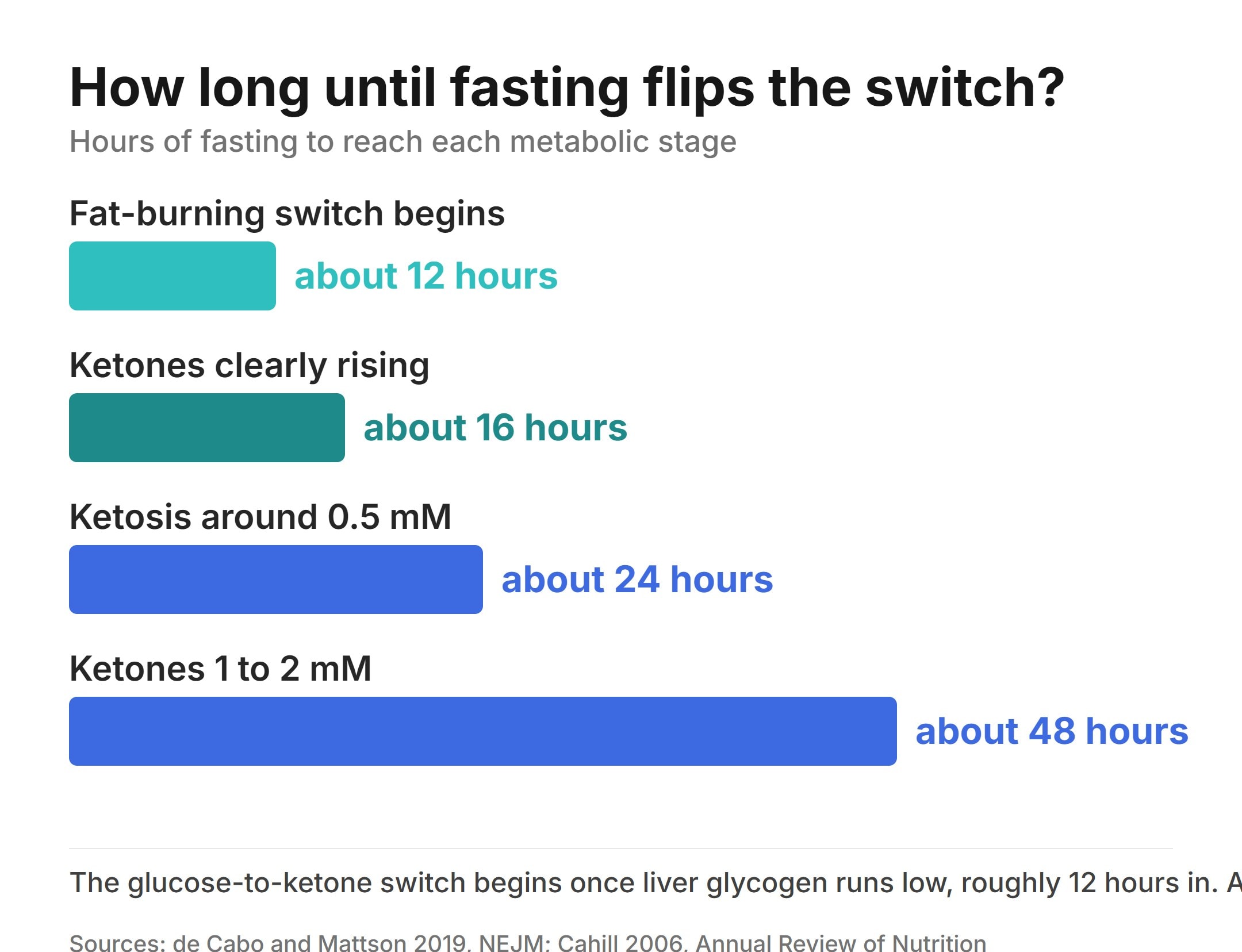
This is the first thing most people get wrong about fasting: they think it’s a gradual transition. You eat less, and your body slowly adjusts. The reality is more dramatic. After approximately 10 to 14 hours without food, your liver glycogen stores deplete, and your body flips , not drifts, flips , to an alternative energy source. The liver begins converting fatty acids into ketone bodies, principally beta-hydroxybutyrate (β-HB), which serve as fuel for your brain, heart, and muscles.
De Cabo and Mattson called this the metabolic switch. It is a real, measurable biochemical event with a specific timeline and a cascade of downstream consequences.
What you already knew: Fasting means your body “burns fat for energy.” Vaguely. As a simplification.
What the science adds: The metabolic switch is a specific event. In humans, blood ketone levels begin rising within 8 to 12 hours of fasting, reaching 0.2-0.5 mM by 24 hours and 1-2 mM by 48 hours. But the switch point , the moment glycogen depletes and fatty acid oxidation becomes primary , isn’t just about fuel. It’s a signaling event. The rising ratio of AMP to ATP activates AMPK, which suppresses mTOR (the master growth signal), which in turn activates autophagy, DNA repair, and antioxidant defense pathways. Every one of these is a repair program.
The new understanding: The metabolic switch doesn’t just change what you burn. It changes what your cells do. The moment the switch flips, your body transitions from growth mode to maintenance mode , from building and storing to auditing, repairing, and recycling. You’ve had this capability your entire life. Three meals a day plus snacks means you’ve never activated it.
The parallel that makes this click: think of it like a factory. During business hours, the assembly line runs , raw materials come in, products go out. But quality control, equipment maintenance, and deep cleaning can only happen when the line shuts down. A factory that runs 24/7 without maintenance windows doesn’t produce more. It produces worse , until it eventually breaks down entirely.
Your cells work the same way. The fed state is production. The fasted state is maintenance. And a body that never enters the maintenance window accumulates the biological equivalent of deferred maintenance , misfolded proteins, damaged mitochondria, cellular debris that slowly degrades function.
What is the difference between the fed and fasted state?
The metabolic switch isn’t just a change in fuel source. It’s a change in cellular priorities. Your body runs fundamentally different programs depending on whether nutrients are coming in or not. The distinction is not subtle , it’s governed by opposing signaling cascades that are essentially mutually exclusive.
- ● Insulin high , signals cells to absorb glucose, store fat
- ● mTOR active , drives protein synthesis, cell growth
- ● Autophagy suppressed , no cellular recycling
- ● IGF-1 elevated , promotes tissue growth and repair
- ● Priority: build, store, grow
- ● Insulin low , cells shift to fat oxidation, ketone production
- ● AMPK active , triggers repair pathways, inhibits mTOR
- ● Autophagy activated , damaged components recycled
- ● BDNF elevated , brain-derived neurotrophic factor rises
- ● Priority: audit, repair, recycle
Both modes are essential. You need the fed state to build muscle, synthesize new proteins, and store energy for future use. You need the fasted state to clean up the damage that accumulates during all that building. The problem isn’t either mode , it’s spending 15 or more hours a day in one mode and almost no time in the other.
As Mattson, Longo, and Harvie documented in their 2017 review in Ageing Research Reviews, the organisms that thrive across virtually every studied species , from yeast to primates , are the ones that cycle between these states. The cycle itself is the signal. Constant feeding isn’t just nutritionally problematic. It’s informationally impoverished , it deprives your cells of the fasting signal that triggers their deepest maintenance programs.
What is autophagy, and does fasting trigger it?
In 2016, the Nobel Prize in Physiology or Medicine was awarded to Yoshinori Ohsumi, a Japanese cell biologist, for discovering the mechanisms of autophagy. The word comes from the Greek: auto (self) and phagein (to eat). Self-eating. It sounds alarming. It is, in fact, one of the most elegant survival strategies in biology.
Autophagy is the process by which your cells identify damaged, dysfunctional, or unnecessary components , misfolded proteins, leaky mitochondria, aggregated waste , wrap them in a double-membrane vesicle, and deliver them to the lysosome for degradation. The components are broken down into amino acids and other building blocks, which are then recycled to build new, functional structures.
Ohsumi’s discovery was decades in the making. The concept of autophagy had been observed since the 1960s, but the molecular machinery remained entirely unknown. Working with baker’s yeast in the early 1990s, Ohsumi starved cells that lacked the enzymes to break down vacuolar contents. Under the microscope, the vacuoles filled with undegraded vesicles , autophagosomes made visible for the first time. By 1993, he had identified 15 genes essential for the process. Those genes turned out to be conserved across virtually all eukaryotic life, including humans.
What you already knew: “Aging means things break down.” Vaguely. As an inevitability.
What the science adds: Autophagy is not constant , it’s regulated. And it declines with age. The older you get, the less efficiently your cells perform this critical maintenance function. Damaged proteins accumulate. Dysfunctional mitochondria persist instead of being recycled. Protein aggregates , the same aggregates implicated in Alzheimer’s, Parkinson’s, and other neurodegenerative diseases , build up because the system that should be clearing them is running at a fraction of its youthful capacity.
The new understanding: Aging isn’t just wear and tear. It’s deferred maintenance. And fasting is one of the most potent activators of the very system that performs that maintenance. When you fast for 16 hours, you’re not “skipping breakfast.” You’re activating a Nobel Prize-winning cellular recycling system that your body increasingly needs and decreasingly triggers on its own. The reframe: intermittent fasting is not a diet. It is a maintenance schedule.
In cell and animal models, autophagy acts as a self-defense mechanism that clears potentially toxic material from cells, including the kinds of protein aggregates implicated in neurodegenerative disease. Whether increasing autophagy through fasting prevents any of these diseases in humans is not established, so treat this as a mechanism, not a medical promise.
The connection to everything else in this library should be apparent. In our article on hormesis, we described how controlled stress activates cellular defense systems , heat shock proteins, Nrf2 pathways, antioxidant upregulation. Autophagy is another branch of the same principle. Fasting is a hormetic stressor. The deprivation is the signal. And the response , cellular self-cleaning at a depth that no supplement, no superfood, and no external intervention can replicate , is the adaptation.
Does the timing of your eating window matter?
There’s a dimension to fasting that most popular accounts miss entirely, and it may be the most practically important one: timing doesn’t just affect how long you fast. It affects what happens when you do.
In 2016, Valter Longo and Satchidananda Panda published a review in Cell Metabolism that connected two fields that had been developing in parallel , fasting biology and circadian science. Their argument was elegant: the benefits of fasting are not just about the duration of nutrient absence. They are about the alignment of eating patterns with the body’s internal clock.
Your liver, pancreas, gut, and adipose tissue all have their own circadian clocks. These peripheral clocks are synchronized by two primary signals: light (via the master clock in the brain) and food (via nutrient-sensing pathways). When you eat at predictable times aligned with your circadian rhythm , roughly during daylight hours , these clocks reinforce each other. Metabolic enzymes peak when food arrives. Insulin sensitivity is highest in the morning and declines toward evening. Digestive efficiency follows the same arc.
When you eat erratically, or extend your eating window deep into the night, these clocks desynchronize. The liver expects rest; you send it glucose. The pancreas has downregulated insulin production; now it has to scramble. Panda’s research showed that in mice, simply restricting food access to the natural active period , without changing the total amount consumed , prevented obesity, improved glucose tolerance, and reduced inflammation. Same calories, same food, different timing. The results were dramatically different.
This is why when you eat may matter as much as how long you fast. An 8-hour eating window from 7 AM to 3 PM (early time-restricted eating) aligns with peak insulin sensitivity and digestive capacity. The same 8-hour window from 2 PM to 10 PM places your largest meals in the period when your body is least prepared to process them. Same fast duration, different metabolic outcomes. Early eating windows consistently outperform late ones in human trials measuring glucose regulation, blood pressure, and oxidative stress. (Longo & Panda, 2016; de Cabo & Mattson, 2019)
The implication is practical and immediate. If you’re going to compress your eating window , and the evidence suggests you should , try to close the kitchen earlier rather than skipping breakfast. Your biology is expecting food in the first half of the day. Working with that expectation amplifies the benefits. Working against it attenuates them.
What does the evidence actually support?
Intermittent fasting has accumulated a substantial body of preclinical evidence and a growing , though still maturing , body of human clinical data. Intellectual honesty requires us to distinguish between what’s well-established and what’s promising but preliminary.
Metabolic health improvements. De Cabo and Mattson’s NEJM review synthesized evidence from multiple human trials showing that intermittent fasting improves insulin sensitivity, reduces fasting insulin levels, and lowers blood pressure. These effects appear across different IF protocols (16:8, 5:2, alternate-day fasting) and are partially , but not entirely , explained by any concurrent weight loss.
Body composition changes. IF consistently produces modest fat loss, typically around 3 to 8% of body weight over several weeks, similar to what daily calorie restriction achieves. Effects on lean mass are mixed and depend heavily on protein intake and resistance training, so fasting is not automatically better for preserving muscle. The mechanism is straightforward: by compressing the eating window, most people naturally consume somewhat fewer calories without deliberate restriction.
Neurological protection. Mattson’s research demonstrated that intermittent fasting increases production of BDNF (brain-derived neurotrophic factor) , a protein critical for learning, memory, and neuronal resilience. Animal studies have examined intermittent fasting in models of neurological stress, with preliminary and mixed results. Researchers caution that human data is limited and does not support disease-prevention conclusions.
Inflammation markers. Some studies have reported changes in markers of systemic inflammation with intermittent fasting, though findings vary across populations and protocols. This connects to the broader hormesis framework , the fasting stress triggers an anti-inflammatory adaptive response that persists into the fed state.
Cancer models (preclinical, not a human claim). In animal and cell studies, fasting and fasting-mimicking diets have shown anti-tumor effects across multiple cancer models, partly through reduced IGF-1 signaling and enhanced immune surveillance. But large-scale human cancer prevention trials are not yet available.
Longevity extension. Caloric restriction extends lifespan in nearly every organism tested, from yeast to primates. Whether intermittent fasting produces equivalent longevity benefits in humans remains an open question , one that may take decades to definitively answer.
Most long-duration human IF studies have relatively small sample sizes. The optimal fasting duration, frequency, and timing for different outcomes remain areas of active investigation. Individual responses vary , some people thrive on 16:8; others find it increases anxiety, disrupts sleep, or triggers disordered eating patterns. IF is also not appropriate for people with a history of eating disorders, pregnant or breastfeeding women, children and adolescents, or individuals with certain metabolic conditions. Consult a physician before starting any fasting protocol.
How to start intermittent fasting
If you’ve read this far, the science case is clear: your body has a maintenance mode you’ve been skipping. The question becomes practical. How do you access it?
The good news is that intermittent fasting is, mechanistically, one of the simplest interventions in this entire library. There are no temperatures to calibrate, no immersion protocols to follow, no timing conflicts with training adaptations. You eat within a window. You stop eating outside it. That’s it.
Here are the four most studied approaches, ordered from most accessible to most demanding:
Start with 14:10 and build. If you currently eat from 7 AM to 10 PM, don’t jump to 16:8 overnight. Close the kitchen at 8 PM. Then 7 PM. Then shift your first meal later by 30 minutes each week. Let your body adapt. The metabolic switch gets easier to reach the more often you reach it , your enzymatic machinery upregulates with practice.
Eat earlier, not later. Based on the circadian evidence, shift your eating window toward the first half of the day when possible. A window of 8 AM to 4 PM is metabolically superior to noon to 8 PM, even though both are technically 16:8. Your insulin sensitivity, digestive efficiency, and thermic effect of food are all highest in the morning.
Hydrate through the fast. Water, black coffee, and plain tea do not break a fast. Staying hydrated makes the fasting window dramatically more comfortable, especially in the first two weeks.
Protect your training. If you’re combining IF with cold exposure, exercise, or other hormetic stressors, schedule your eating window to include a post-training meal. As we covered in our athletic recovery article, nutrient timing around resistance training matters for muscle protein synthesis. Fast in the morning, train in the afternoon, eat after training , this is the pattern that preserves both the fasting benefits and the training adaptations.
Listen to the signals. If you feel sharp, focused, and energetic during the fast , that’s the ketones and BDNF talking. If you feel anxious, light-headed, or obsessively thinking about food after two weeks of consistent practice, your body may be telling you the window is too aggressive. Widen it. Hormesis requires the right dose. More is not always better.
Cold exposure and fasting activate overlapping molecular pathways , both trigger AMPK, both upregulate Nrf2-mediated antioxidant defenses, both stimulate autophagy. As we explored in our article on the hormesis principle, these are not separate interventions. They are different inputs into the same adaptive system. A morning cold plunge followed by a fasted period until midday is not two protocols. It’s one signal, delivered through two channels, telling your body: maintain, repair, strengthen.
We live in an economy of abundance, and we’ve mistaken constant consumption for health. More supplements. More meals. More inputs. But the deepest maintenance your cells perform , the recycling of damaged proteins, the renewal of mitochondria, the clearing of the molecular debris that accumulates with every day of living , happens only in the absence of input. Only when you stop feeding them do your cells start fixing themselves.
This isn’t deprivation. It’s rhythm. The same rhythm that governed human biology for hundreds of thousands of years before we decided that a 15-hour feeding window was normal. Your body already knows how to do this. You just have to give it the time.
Frequently asked questions
How long do you have to fast for intermittent fasting to work?
The metabolic switch from glucose to fat and ketones begins once liver glycogen runs low, roughly 12 or more hours into a fast, which is why a 16:8 pattern (16 hours fasting) reaches it comfortably. Deeper ketosis and more autophagy build the longer you fast, but the everyday benefits do not require extreme fasts.
What is the metabolic switch?
It is the point where your body runs out of easily available glucose and shifts to burning fat, producing ketones as fuel. This usually starts around 12 hours of fasting and is the mechanism behind most of intermittent fasting benefits.
Does fasting trigger autophagy?
Fasting does upregulate autophagy, the cellular cleanup process Yoshinori Ohsumi won the 2016 Nobel Prize for mapping. The strongest evidence for exactly how much and how fast comes from animal and cell studies, so treat human autophagy timing as promising rather than precisely known.
Which is better, 16:8 or a longer fast?
For most people 16:8 is the practical sweet spot: it clears the metabolic switch and is easy to sustain daily. Longer fasts deepen ketosis but add little for everyday health and are harder to keep up. When you eat may matter as much as how long, so try to shift your eating window earlier in the day.
Does intermittent fasting help you lose weight?
Yes, modestly, usually around 3 to 8% of body weight over several weeks, mainly because a shorter eating window tends to cut total calories. Results are broadly similar to daily calorie restriction, so the best plan is the one you can actually stick to.
Stack your recovery tools, do not pile on stress
Fasting, cold exposure, and training are all hormetic stressors, and dose still matters when you combine them. A controlled, repeatable cold session is easy to schedule around your eating window and your training. The Vitalis 3 holds any set point from 2 to 40°C, so you can dial the dose instead of guessing.
- de Cabo R, Mattson MP (2019). Effects of intermittent fasting on health, aging, and disease. New England Journal of Medicine 381(26):2541-2551. doi.org/10.1056/NEJMra1905136
- Mattson MP, Longo VD, Harvie M (2017). Impact of intermittent fasting on health and disease processes. Ageing Research Reviews 39:46-58. doi.org/10.1016/j.arr.2016.10.005
- Longo VD, Panda S (2016). Fasting, circadian rhythms, and time-restricted feeding in healthy lifespan. Cell Metabolism 23(6):1048-1059. doi.org/10.1016/j.cmet.2016.06.001
- Gill S, Panda S (2015). A smartphone app reveals erratic diurnal eating patterns in humans that can be modulated for health benefits. Cell Metabolism 22(5):789-798. doi.org/10.1016/j.cmet.2015.09.005
- Cahill GF Jr (2006). Fuel metabolism in starvation. Annual Review of Nutrition 26:1-22. doi.org/10.1146/annurev.nutr.26.061505.111258
- The Nobel Prize in Physiology or Medicine 2016: Yoshinori Ohsumi, for discoveries of mechanisms for autophagy. The Nobel Assembly at Karolinska Institutet. www.nobelprize.org/prizes/medicine/2016/summary/